

They will tell you it happened suddenly. They will tell you it’s complicated. They will tell you that reasonable people can disagree about what the founders intended, that the Constitution is a living document, that times change, that the separation of church and state is — and here is the phrase they have been field-testing for decades — just a myth.
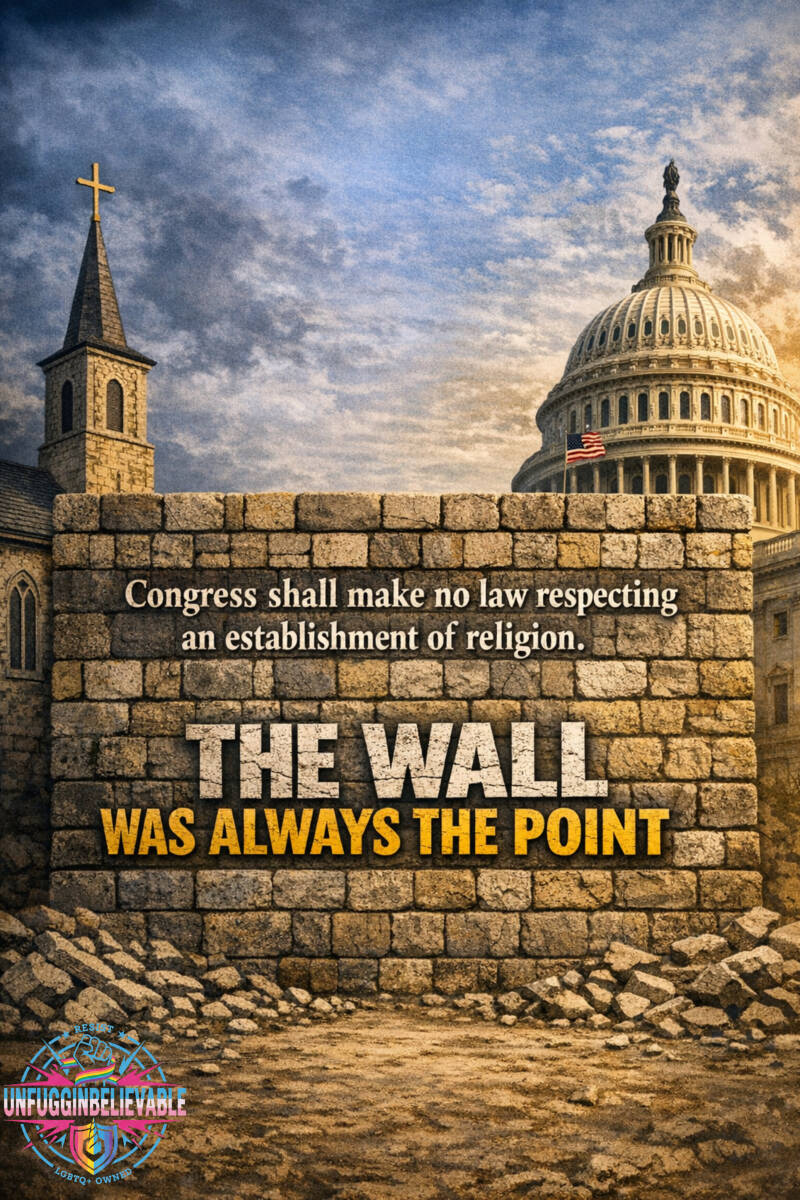
It is not a myth. It is ten words. Congress shall make no law respecting an establishment of religion. The founders put it first. Not buried in a footnote, not tucked into an amendment nobody reads, not implied between the lines. First. Before the free press. Before the right to assemble. Before the right to bear arms, which is the one they will mention loudest when they want you to stop paying attention to the one that comes before it.
They put it first because they knew something the people currently dismantling it are counting on you to forget: they had seen what happens when the wall comes down. They had lived under it. They had fled it, fought it, written home about it in letters that still exist, that you can read, that say in plain language what they understood about the relationship between state power and religious authority. Jefferson called the establishment clause a wall of separation between church and state. Madison warned that even compelling a citizen to contribute a single penny to a religious institution he did not choose violated the natural right to conscience. Roger Williams — a minister, not a secularist — said a government entangled with religion would corrupt both. These were not fringe positions. They were the architecture.
The architecture is being demolished. And it did not start last week.
The project has a name. It has a budget. It has a 116-page playbook, a network of 950 state legislators across 38 states, and a 30-year timeline that one of its principal architects described out loud, on camera, with evident satisfaction. It is called Project Blitz, and it was launched in 2015 by a coalition of Christian right groups including the Congressional Prayer Caucus Foundation, the National Legal Foundation, and an organization called WallBuilders. WallBuilders is run by a man named David Barton, who bills himself as America’s premier historian. He is absolutely NOT a historian. He has a bachelor’s degree in religious education from Oral Roberts University, no formal training in history or law, and a publishing record so riddled with fabricated quotes and falsified citations that his own Christian publisher pulled his flagship book in 2012 after conservative scholars concluded it was trafficking in what they called embarrassing factual errors, suspiciously selective quotes, and highly misleading claims. His publisher lost confidence. His audience never did.
Barton’s central thesis — that the separation of church and state is a myth manufactured by activist judges, that the founders intended a Christian nation governed by biblical law — has been rejected by professional historians across the ideological spectrum. It has been called pseudo-history, revisionism, and, by one Baptist scholar who spent decades studying it, outright deception of honest but naive Christians. None of that stopped it from becoming the intellectual foundation for a coordinated, multi-decade legislative campaign designed to inch the wall down one statute at a time.
The strategy was explicit and deliberate. Project Blitz divided its model legislation into three categories based on how much opposition each bill was expected to generate. Start with the easy ones. Require public schools to display the national motto — In God We Trust — in classrooms and hallways. Why that is our national motto is beyond us, but that’s for another day. Offer In God We Trust license plates. Pass resolutions affirming America’s Christian heritage. These first bills were designed, in the playbook’s own words, to appear the most innocuous. Build momentum. Normalize the premise. Move the goalposts so gradually that by the time you reach the third category — legislation empowering professionals to deny health care, services, and adoption placements based on religious belief — it feels like the natural conclusion of something that began with a motto on a wall.
It worked. In 2018 alone, state legislators introduced 74 bills drawn directly from the Project Blitz handbook. At least ten states now require In God We Trust to be displayed in public schools. At least ten states have passed laws allowing taxpayer-funded adoption agencies to reject families on religious grounds. The playbook went underground in 2019 — its authors stopped making it publicly available — but the bills kept coming. By 2020, 92 had been introduced. By 2021, 74 more, with an increasing number actually passing.
The gap implied by separation is closed by inches, not miles. What first presents as innocuous, commonsense even, can transform a nation. That is not a warning from an alarmist. That is a description of the plan.
Meanwhile, a parallel project was running through the courts. The Federalist Society spent decades building a pipeline of judges — federal, appellate, Supreme — selected not only for their conservatism but for their specific jurisprudential views on religious liberty. The results are now visible in the decisions. In 2022, the Supreme Court ruled in Kennedy v. Bremerton that a public school football coach had the right to pray on the fifty-yard line after games. The six-justice majority didn’t just rule for the coach. They used the case to declare that the legal standard that had governed establishment clause analysis for more than fifty years — a test that asked whether a government action appeared to endorse religion — was no longer good law. They threw it out. Replaced it with a vague instruction to consult historical practices and understandings. They did not define what that means. Lower courts are still trying to figure it out. That ambiguity is not an accident. Legal scholars warned immediately that what was opened was a door, and that people determined to promote their religion in public institutions would walk through it.
That same term, the Court ruled that states must fund religious private schools if they fund secular private schools. The next year, in 303 Creative, the Court ruled that a business owner could refuse services to customers whose lives conflicted with her religious beliefs and call it free speech. Each ruling built on the last. Each one moved the wall.
And then there is the Speaker of the House. Mikey Johnson told an interviewer in 2023 that the separation of church and state is, in his words, a misnomer. That Jefferson’s letter to the Danbury Baptists — the letter in which Jefferson used the exact phrase “wall of separation between church and state” — was actually about protecting the church from the government, not the other way around. This is not a novel interpretation. It is a talking point, verbatim, from the Project Blitz playbook. The Speaker of the United States House of Representatives is using the pseudo-historian’s script. He also described David Barton, with typical Retrumplican irony deficiency, as one of the most important people he knew.
This is where this first piece ends and where the rest of the series begins. Because what we have described so far is the foundation — the decades of legal architecture, legislative strategy, revisionist history, and judicial capture that made everything that comes next possible. The classrooms. The courtrooms. The government agencies. The Pentagon podium.
The wall was always the point. Take it down, and everything the state was prohibited from doing to your conscience becomes available again.
We’re going to show you exactly how they did it. Piece by piece.
**Unfugginbelievable is an independent, reader-supported investigation into the things that make us want to flip a table — then flip it back over and document everything on it. Every claim is fact-checked. Every source is real. No ads, no sponsors, no corporate overlords telling us what to leave out. If this work matters to you and you want to keep us caffeinated while we do it, buy us a cuppa at buymeacoffee.com/unfugginbelievable. We’ll drink it while reading the next filing.
Add comment
Comments