

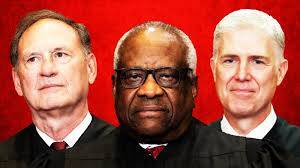
They told us Section 2 was still standing. They lied.
On April 29, 2026, the Supreme Court handed down its ruling in Louisiana v. Callais, a 6-3 decision split cleanly along ideological lines — six conservative justices in the majority, three liberal justices in dissent. Justice Samuel Alito wrote the opinion. He was at pains to say the court was not striking down Section 2 of the Voting Rights Act of 1965. He wanted you to understand that. He wanted the record to reflect it. Section 2, Alito assured us, remains on the books.
Justice Clarence Thomas, writing separately in concurrence, joined by Justice Neil Gorsuch, wanted you to understand something else entirely. No Section 2 challenge to redistricting, Thomas wrote, should ever succeed. He has held this view for more than thirty years. He put it in writing again on Tuesday, in 2026, for the record. The statute may stay on the books. It just shouldn’t do anything.
Between Alito’s careful wording and Thomas’s open declaration, you have the full picture: a law that exists in name while its enforcement mechanism has been dismantled, and a member of the court telling you plainly that’s exactly the point.
Welcome to the end of the Voting Rights Act. They just didn’t say it out loud.
Here’s what Section 2 actually was, and what it now isn’t. The Voting Rights Act was signed into law in 1965, weeks after civil rights marchers were beaten on a bridge in Selma, Alabama. Section 2 was the enforcement mechanism — the provision that made racial discrimination in voting a legally actionable wrong. In 1982, Congress strengthened it specifically to address a 1980 Supreme Court ruling. That amendment established a “disparate impact” standard: you didn’t have to prove that a legislature sat in a room and said, out loud, we are drawing this map to dilute Black votes. You only had to prove that it did. Results, not rhetoric. Outcomes, not intent. Congress chose that standard deliberately, because they understood that discriminatory intent is exactly the kind of thing that gets laundered and concealed.
For forty years, that standard held. It gave Black voters in Louisiana, Alabama, Georgia, and elsewhere a legal foothold. It meant that when a state with a one-third Black population drew congressional maps that gave Black voters real influence in exactly one of six districts, a court could look at the math, look at the map, and say: this is wrong, fix it.
The Supreme Court just erased that standard.
Alito’s majority opinion rewrites Section 2 to require proof of intentional discrimination — the exact high bar Congress specifically designed the 1982 amendment to remove. States can now draw maps that systematically dilute the power of Black and brown voters, and those maps are constitutionally protected unless you can prove someone in the legislature meant to do it. Prove it. With documentation. In court. Good luck.
This wasn’t an accident. It wasn’t an oversight. It was a project.
Chief Justice John Roberts has been working toward this since the Reagan administration, when as a young Justice Department lawyer he argued internally that Section 2 went too far, that regulating discriminatory results rather than discriminatory intent exceeded constitutional bounds. He said as much in those memos. He has never stopped believing it. In 2013, in Shelby County v. Holder, Roberts gutted the VRA’s preclearance provisions — the requirement that jurisdictions with histories of discrimination get federal sign-off before changing voting laws. He wrote, with a straight face, that things had changed in the South and extraordinary oversight was no longer needed. Section 2, he assured us, remained as a backstop.
It did, until Wednesday, when Roberts joined Alito’s majority and the backstop disappeared.
Justice Elena Kagan took the rare step of reading her dissent from the bench. She was joined by Justices Sonia Sotomayor and Ketanji Brown Jackson. Kagan said the decision renders Section 2 “all but a dead letter.” She described what the ruling actually permits: a minority community that is geographically coherent, politically cohesive, and facing continued racial adversity gets “cracked” — split across districts so their votes are swallowed by surrounding majorities. They can still go to the polls. They just can’t hope to elect anyone who represents them. Their votes count. They just don’t matter.
That is not a technicality. That is voter suppression with a bow on it.
Now combine this ruling with the Supreme Court’s 2019 decision in Common Cause v. Rucho, which held that courts cannot block partisan gerrymandering. Rucho said: not our problem, that’s politics. Callais says: not only can’t you challenge the partisan maps, but now you can’t challenge the racial ones either unless you have a documented confession. The combination of those two rulings effectively declares all gerrymandering constitutional. Pick your voters. Draw your lines. The Court will not stop you.
The numbers are not abstract. An analysis by Fair Fight Action and Black Voters Matter found that Callais could eventually enable a redistricting wave across the South that flips as many as 19 majority-minority seats currently held by Democrats. NPR’s analysis puts the near-term number at 15 House seats currently held by Black members of Congress that could be redrawn out from under them — producing, as Democracy Docket put it, a level of racial revanchism in electoral representation not seen since the end of Reconstruction.
Fifteen seats. In Congress. Because the maps said so, and now nothing can stop it.
For the midterms specifically, the timing limits the immediate carnage somewhat. The ruling arrived too late in the election cycle for most states to fully redraw their maps in time for November. But Florida is already in a special legislative session targeting four seats. Texas, Missouri, North Carolina, and Ohio have already moved. Republicans are operating with urgency because they understand exactly what this ruling permits. Democrats have fewer clear pickups available in the states they control and face more internal resistance to mid-decade redistricting. The playing field is not symmetrical.
And this is just Round One. The court has been sitting on multiple pending cert petitions asking whether Section 2 even has an implied right of private enforcement — meaning whether ordinary citizens can sue under it at all, even under the gutted standard. Those petitions are now expected to move quickly, in the wake of Callais. What’s left of Section 2 may be challenged at the root next term.
Thomas told you where this ends. He’s been telling you for thirty years.
Justice Kagan said the majority’s approach risks unraveling decades of civil rights law. She said that ignoring the real-world operation of racial discrimination doesn’t produce neutrality — it entrenches inequality. She said the Reconstruction Amendments were designed as tools of inclusion, and the court has recast them as constraints on remediation. The Constitution, she argued, permits Congress to confront discrimination as it actually functions, not merely as it appears in sanitized legislative records.
She’s right. She was also on the losing side, 6-3.
The Voting Rights Act was not merely a statute. It was a national commitment. It was the government’s formal acknowledgment that voting discrimination was real, persistent, and required active remedy. It was the legislative response to Selma. It was a promise made in blood and law. And this court — this particular court, shaped by a decades-long legal project, stacked with justices who were chosen for exactly this purpose — has hollowed it out.
They left the shell. Alito wanted credit for leaving the shell.
But the enforcement mechanism that made Section 2 work is gone. The backstop Roberts promised in 2013 is gone. The protection Congress specifically designed in 1982 to reach discrimination that hides behind neutral language is gone. And a justice on the majority is in the record saying none of it should have ever applied to redistricting in the first place.
This is not a ruling about Louisiana’s congressional map. This is a ruling about who gets to have a government that answers to them. This is a ruling about whose votes translate into representation, and whose votes become decorative. This is a ruling about what “equal protection” means when the court decides that confronting inequality is itself a form of inequality.
It means nothing. It means whatever six justices say it means. And right now, six justices say it means this.
The midterms are in November. The maps are already being redrawn. The Countdown to the Coup is running.
Tally your dead letters accordingly.
**Unfugginbelievable is an independent, reader-supported investigation into the things that make us want to flip a table — then flip it back over and document everything on it. Every claim is fact-checked. Every source is real. No ads, no sponsors, no corporate overlords telling us what to leave out. If this work matters to you and you want to keep us caffeinated while we do it, buy us a cuppa at buymeacoffee.com/unfugginbelievable. We’ll drink it while reading the next filing.
Add comment
Comments