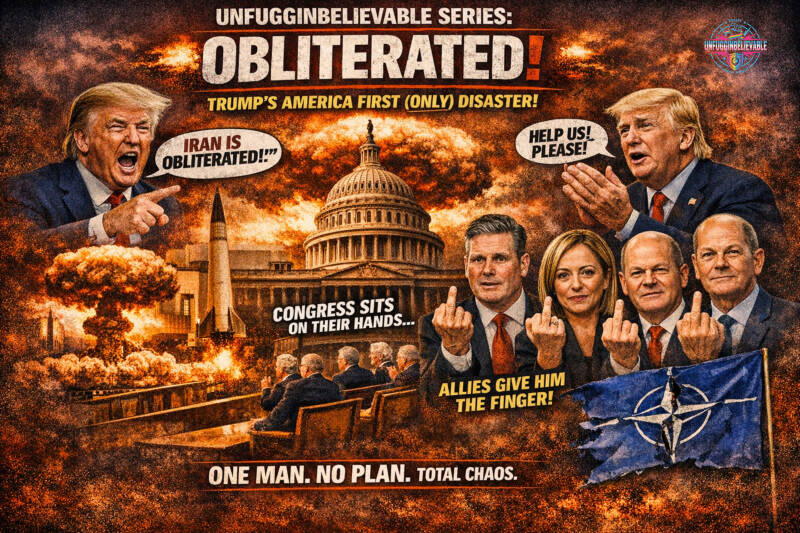
OBLITERATED

A No More Endless Wars Series

In June 2025, Donald Trump told America he had obliterated Iran’s nuclear program. He said it over a dozen times. Obliterated. Done. Gone. We won.

Nine months later, he started a war with Iran.

This series is about that. Not the spin, not the counter-spin — the documented, on-the-record, said-it-yourself facts of how the United States ended up in another war nobody voted for, nobody authorized, and nobody can define a way out of. It’s about who’s winning — hint: it isn’t us. It’s about who’s paying — hint: it’s you. It’s about who’s doing nothing — hint: they work in a building with a dome on it.

We’re angry. You should be too. But anger without facts is just noise. Obliterated is facts with attitude — because the facts are enraging enough on their own.

Seven parts. One war. Zero good reasons.


PART ONE: THE WORD THEY CHOSE

Let's start with the word. Their word. Said out loud, on camera, to the American people, flanked by the Vice President of the United States, the Secretary of State, and the Secretary of Defense. "Iran's key nuclear enrichment facilities have been completely and totally obliterated." That was Donald Trump. June 21, 2025. The night of Operation Midnight Hammer. He said it with the finality you use when something is done. Finished. Gone. Obliterated. Not damaged. Not set back. Not degraded. Obliterated. The word means utterly destroyed. Wiped out. The kind of thing you cannot un-obliterate.

Read more »

PART TWO: KEGSBREATH

Every morning, Pete Hegseth puts on his dangerously tight suit — he is a civilian now, though he seems to keep forgetting — walks to the Pentagon briefing room, stands in front of a podium that has held people like Colin Powell, Robert Gates, and James Mattis, and tells America we are winning. Not just winning. Winning decisively. Yesterday was the biggest day of strikes. Today will be bigger. Tomorrow will be bigger than that. The enemy is crumbling. Iran's air force is gone. Its navy is gone. Its air defenses are flattened. Its industrial base is overwhelmingly destroyed. We are, every single day according to Pete Hegseth, at the apex of a glorious and relentless American victory.

Read more »

PART THREE: THE ASK

On day one of the war, Trump posted on Truth Social that the bombing would continue throughout the week, "or as long as necessary." On day two, he said it would last "until all of our objectives are achieved." On day three he told the New York Times four to five weeks. Then he told the Daily Mail four weeks or less. Then he told NPR it could go far longer. On day five, Hegseth told Pentagon reporters it could be four weeks, six weeks, eight weeks, or three — "ultimately, we set the pace and the tempo." On day seven, Trump posted on Truth Social: "There will be no deal with Iran except UNCONDITIONAL SURRENDER!" On day ten he told a reporter it would be over "soon. Very soon." On day eleven, he told a Medal of Honor ceremony at the White House that the war was "substantially ahead of schedule" while simultaneously saying "we’ve got to finish the job." On day thirteen he said "we’ve already won in many ways, but we haven’t won enough." Asked if the war was beginning or complete, he said: "Well, I think you could say both."

Read more »

PART FOUR: THE WINNER

Vladimir Putin did not start this war. He didn’t fund it, plan it, lobby for it, or ask for it. He didn’t need to. He just woke up on the morning of March 1, 2026, turned on the television, watched the Strait of Hormuz go dark, and had what can only be described as the best week of his presidency. Then the week after that was even better. Then the week after that. 

Read more »

PART FIVE: THE ALLIANCE

There is a piece of twisted steel outside NATO headquarters in Brussels, Belgium. It came from the 107th floor of the North Tower of the World Trade Center. It sits on a pedestal. In front of it, a plaque. The inscription commemorates the only time in NATO’s seventy-six-year history that Article 5 — the mutual defense clause, the heart of the alliance, the promise that an attack on one is an attack on all — has ever been invoked. September 12, 2001. The day after the United States was attacked. NATO didn’t wait to be asked. The Secretary General called an emergency session, and within twenty-four hours, all eighteen member nations said: we’re with you. More than a thousand NATO soldiers eventually died in Afghanistan fighting alongside Americans in the years that followed. Seven AWACS radar aircraft, crewed by 830 service members from thirteen countries, flew over 360 sorties patrolling American skies in the months after the attacks. A piece of the building where nearly 3,000 Americans died sits outside NATO’s front door. Not as a trophy. As a reminder.

Read more »

PART SIX: THE ABDICATION

The Constitution of the United States is not ambiguous on this point. Article I, Section 8 vests in Congress the power to declare war. Not the power to suggest war. Not the power to advise on war. Not the power to feel complicated about war and issue a statement. The power to declare it. George Washington — the man who commanded the Continental Army, the man who understood executive military power better than anyone alive in 1793 — wrote in a letter to William Moultrie: "No offensive expedition of importance can be undertaken until after they have deliberated upon the subject, and authorized such a measure." James Madison wrote that the executive has "no right, in any case, to decide the question, whether there is or is not cause for declaring war."James Monroe wrote that "the Executive has no right to compromit the nation, in any question of war." These are not fringe interpretations. These are the founders. In their own words. On the record. Congress declares war. The president commands the forces once war is declared. That is the design.

Read more »

PART SEVEN: WHY NOW?

We are not going to tell you why Donald Trump started this war. We are going to tell you what we know. What was happening on February 28, 2026, and in the weeks before it. What the numbers said. What the documents said. What the people around him said. What he said. And then we are going to let you sit with it, because the question of why a president starts a war without authorization, without coalition, without defined objectives, and against the explicit assessment of his own intelligence community is not a question that resolves cleanly. It is a question that demands to be asked. Loudly. Repeatedly. By everyone.

Read more »