

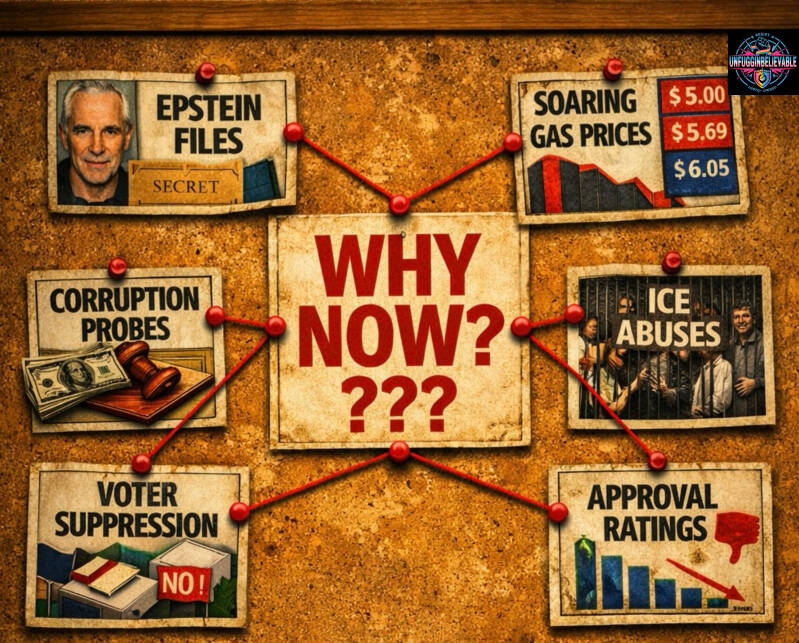
We are not going to tell you why Donald Trump started this war. We are going to tell you what we know. What was happening on February 28, 2026, and in the weeks before it. What the numbers said. What the documents said. What the people around him said. What he said. And then we are going to let you sit with it, because the question of why a president starts a war without authorization, without coalition, without defined objectives, and against the explicit assessment of his own intelligence community is not a question that resolves cleanly. It is a question that demands to be asked. Loudly. Repeatedly. By everyone.
On February 3, 2026, the Department of Justice released the Epstein files. Not all of them — Attorney General Pam Bondi had been promising a client list was sitting on her desk since February 2025, and the administration had made a theatrical production of inviting pro-Trump influencers to the White House to receive binders labeled "The Epstein Files: Phase 1" — but enough to ignite a four-alarm political fire. The files ensnared Prince Andrew, who was arrested along with former UK Ambassador to the US Peter Mandelson, rocking the Starmer government and creating an international incident. Israel’s former Prime Minister Ehud Barak was implicated. Allegations that Epstein had operated as a Mossad intelligence asset moved from fringe to mainstream discussion. Several prominent figures in the United States resigned government positions over connections to Epstein. And Trump’s own relationship with Epstein — the decades of documented social ties, the party circuit, the 2002 quote in New York Magazine where Trump called Epstein "a terrific guy" who likes beautiful women "on the younger side" — was front-page news, wall-to-wall, inescapable.
FBI Director Kash Patel — who had spent years as a MAGAt media figure calling for Epstein’s associates to be arrested and prosecuted — suddenly reversed course and claimed there was "no credible information" that Epstein had ever trafficked minors to anyone other than himself. Patel said this. On the record. The same Kash Patel who had been loudly, publicly, relentlessly demanding Epstein accountability for years. Google searches for “Epstein files” were among the most sustained in the platform’s history. The story was not going away.
On February 13 to 16, 2026 — two weeks before the war started — an Economist/YouGov poll found that a majority of Americans disapproved of Trump overall and that even more disapproved of his handling of the Epstein investigation. By February 22, an ABC News/Washington Post/Ipsos poll found that 64 percent of Americans disapproved of Trump’s handling of tariffs. His tariff approval rating lagged behind his already-underwater overall approval rating, which itself was at its lowest point in either term. The Marist Poll, released in the final days of February, had his overall job approval at 38 percent, his economic approval at 36 percent, and found that 61 percent of Americans said the economy was not working for them personally. A February 27 YouGov poll, conducted the day before the strikes began, had Trump at his lowest net approval rating of his entire second term.
Trump had gone to a House Republican retreat at the Kennedy Center on January 6, 2026 — the five-year anniversary of the Capitol attack, a choice that was either oblivious or deliberate and was neither accidental — and told members: "I wish you could explain to me what the hell’s going on with the mind of the public." He added, according to CNN: "Now, I won’t say, ‘Cancel the election.’" He said the words "cancel the election"to a room of House Republicans, with a "won’t say" in front of them, which is precisely how you say something while preserving deniability that you said it. It was not the first time. Trump had told Ukrainian President Zelenskyy in a private meeting, later leaked, that countries at war don’t hold elections — pointing to Ukraine’s suspended elections as a model. He had told a radio host that "maybe we should have no elections for a while."The White House called each instance a joke. The pattern is not a joke. A pattern of repeated, deniable statements about suspending elections is not a joke. It is a trial balloon floated so many times it has its own flight path.
Two weeks before the war started, Trump allies were circulating a 17-page draft executive order, reviewed in full by PBS News, that would declare a national emergency on the grounds of foreign election interference and grant the president extraordinary powers over the 2026 midterm elections. The draft would require all 211 million registered voters in America to re-register in person at a county election office, with original birth certificate, passport, or naturalization certificate, before the November election. It would prohibit most mail-in voting. It would require hand-counting of ballots nationwide. A White House official told PBS News that the administration was in regular contact with outside advocates who wanted to share policy ideas. Trump denied he was considering it. The draft existed. It was detailed. It had been in circulation, according to attorney Peter Ticktin, who confirmed it, "for a while now."
On February 28, 2026, the United States began bombing Iran.
Within days, Google searches for “Epstein files” had plummeted. Shaiel Ben-Ephraim, an analyst with Atlas Global Strategies and a former Israeli diplomat, told Al Jazeera directly: Trump "needs a distraction from [his domestic issues] in the form of a war"and the Epstein search collapse was evidence it was "at least temporarily, succeeding. It’s taking up Congress’ time and it’s taking up the media’s time." A Data for Progress poll conducted March 6 to 8 — the first week of the war — found that 52 percent of likely American voters believed Trump launched the war at least in part to distract from the Epstein scandal. Among voters under 45, it was 66 percent. Among Democrats, 81 percent. Even 25 percent of Republicans believed it. Thomas Massie, Republican, co-sponsor of the war powers resolution, posted on X: "PSA: Bombing a country on the other side of the globe won’t make the Epstein files go away." Senator Jeff Merkley said publicly that the war appeared designed in part to bury Epstein. They are not fringe voices. They are members of Congress who have the clearances, have been to the classified briefings, and have looked at the intelligence. And they are saying this.
The White House called the distraction theory "ridiculous" and its proponents "true morons." The forceful, personal nature of the pushback — not a measured denial but an immediate, name-calling rage — is itself data. Administrations dismiss baseless theories. They attack theories that are hitting something real.
Now add the midterm layer, because it is inseparable from everything above. Midterms are eight months away. The polling entering February 2026 showed Democrats with a structural advantage: Trump’s approval was underwater on every major issue — the economy, tariffs, cost of living, Epstein — and independent voters, whose defection cost Republicans the House in 2018 during Trump’s first term, were breaking hard against him again. Republican strategists, speaking to Axios and Politico privately, were describing the electoral map in terms they hadn’t used since October 2018. The House majority, razor-thin at 219 seats, was looking precarious. If Democrats reclaim the House in November, the legislative agenda stops. The investigations start. The subpoenas go out. The documents come in. The Epstein files, the ones still buried, become a matter of congressional inquiry rather than executive discretion.
A wartime president is a different political animal than a peacetime one. Rally-around-the-flag effects are real and documented — George W. Bush went from 51 percent approval in September 2001 to 90 percent after 9/11, the highest recorded presidential approval in the history of modern polling. Trump understood this from his first term, when he periodically escalated tensions with Iran — including the assassination of Qasem Soleimani in January 2020 — in periods of domestic political stress. The Iran war produced a modest rally effect: the Economist/YouGov poll from March 6 to 9 showed a rebound in Trump approval, and CNN’s chief data analyst noted that among self-identified MAGA Republicans, support for military action in Iran was running at 90 percent. The base was energized. The question of whether that energy translates to November — whether it holds, whether it expands beyond the base, whether the economic damage from $111 oil outweighs the flag-waving — is the question Republican strategists are watching in real time. Still waiting to see all of those warmongering MAGAts to enlist…
And then there is the election intervention piece, which is not speculation. It is documented. The draft executive order existed. The conversations with outside allies about national emergency powers and election control existed. Metamucillini’s own statements about canceling or suspending elections existed — multiple times, in multiple contexts, each dismissed as a joke, accumulating into a documented pattern. The Center for American Progress noted that the 17-page draft order would have made it effectively impossible for tens of millions of Americans to re-register in time to vote in November — not by canceling the election, but by burying it under procedural requirements designed to suppress turnout in Democratic constituencies. You don’t need to cancel an election to win one you would otherwise lose. You need to change who gets to participate in it.
Senator Chris Murphy had been saying since May 2025 — nine months before the war started — that there was no guarantee of a free and fair election in 2026. He told MSNBC: "We can’t be preparing for the 2026 election. It might not come." That sounded alarmist at the time. Then Trump said "cancel the elections" to a room full of House Republicans on January 6. Then the 17-page draft executive order surfaced on February 26. Then the war started on February 28. The U.S. Constitution website put the core logic plainly: "Emergency powers don’t include election cancellation because elections are the ultimate check on emergency powers. If presidents could cancel elections during crises, they could create or prolong crises to avoid electoral accountability."
That sentence deserves to be read twice.
We are not saying Trump started a war to cancel the midterms. We are saying: his approval was at its lowest point in either term. The Epstein files were consuming his presidency. A draft executive order to seize control of the elections was circulating among his allies. He had said, out loud, to House Republicans, the words "cancel the election." He had told Zelenskyy that wartime countries don’t hold elections. And then he started a war. Without authorization. Without coalition. Without defined objectives. Against the assessment of his own intelligence community. On no imminent threat.
These are the facts. In sequence. On the record.
A Reuters/Ipsos poll released March 20 — the day before this series concludes — found that most Americans now expect the US to send ground troops into Iran. Trump said he wouldn’t tell us if he were planning to. The USS Boxer is already in the Persian Gulf. Thirteen Americans are buried. More than fourteen hundred Iranians are dead. The Strait of Hormuz is closed. Oil is at $111 a barrel. Vladimir Putin is having the best year of his presidency. Congress has voted eight times and done nothing. The $200 billion ask sits in the Capitol waiting for someone with the authority to act on it to use that authority. The midterms are eight months away.
The Epstein files are still out there.
Lawyer Ann Olivarius, who represents survivors of sexual abuse, said it the week the war started: "The war will not extinguish this. The floodlight of attention will swing back in due course."
Thomas Massie said it simpler: "Bombing a country on the other side of the globe won’t make the Epstein files go away."
We have now documented, across seven pieces and seven weeks of war, the following: a nuclear program the administration spent nine months calling obliterated that somehow required a new war; a boozy Secretary of Defense who lies about strike data daily, declared a war crime on camera, and oversaw the dismantling of the systems designed to prevent a girls’ school from being bombed; a $200 billion funding request for a war the president simultaneously claims is over; a strategic windfall for Vladimir Putin that experts measure in the hundreds of billions of dollars; an allied community that said no to an illegal war and got called cowards for it; a Congress that abdicated its constitutional responsibility eight times and counting; and a question — why now, why this, why without asking anyone — that the administration has never answered and never will.
We have been careful throughout this series not to claim certainty we don’t have. We don’t know why Trump started this war. Nobody outside a very small room knows. What we know is what was happening when he started it, what the intelligence said, what his own officials said privately, what the documents show, and what the pattern of his behavior across both terms suggests about how he uses power when he is cornered.
We know this: thirteen Americans are dead in a war nobody voted for, nobody authorized, and nobody can define the end of.
That is enough. That has always been enough.
Ask the question. Keep asking it. Make them answer it.
The midterms are eight months away. Vote like the next seven depend on it. Because they do.
**This is the final installment of Obliterated, the No More Endless Wars series. Seven pieces. One war. Every claim fact-checked. Every source real. No ads, no sponsors, no one with a stake in what we leave out. Unfugginbelievable is independent, reader-supported journalism built on the conviction that the truth, stated plainly and sourced rigorously, is the most dangerous thing we can publish. If this work mattered to you, keep us going at buymeacoffee.com/unfugginbelievable. We’ll use it to keep reading, keep documenting, and keep asking the questions they’re betting we’ll stop asking.
Add comment
Comments