

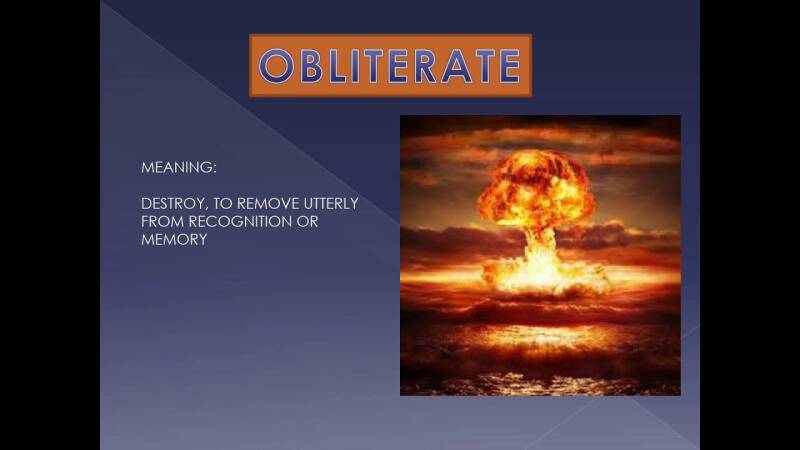
Let's start with the word. Their word. Said out loud, on camera, to the American people, flanked by the Vice President of the United States, the Secretary of State, and the Secretary of Defense. "Iran's key nuclear enrichment facilities have been completely and totally obliterated." That was Donald Trump. June 21, 2025. The night of Operation Midnight Hammer. He said it with the finality you use when something is done. Finished. Gone. Obliterated. Not damaged. Not set back. Not degraded. Obliterated. The word means utterly destroyed. Wiped out. The kind of thing you cannot un-obliterate.
He wasn't alone in choosing it. Marco Rubio called it "complete and total obliteration."Pete Hegseth said the bombing "obliterated Iran's ability to create nuclear weapons."Steve Witkoff, Trump's own envoy, said Fordow was "obliterated" and that suggestions otherwise were "just completely preposterous." Tulsi Gabbard, Director of National Intelligence, put it in writing — formal Senate testimony — that "Iran's nuclear enrichment program was obliterated" and that there had been "no efforts since then to try to rebuild their enrichment capability." The White House published an article on whitehouse.gov. The title: "Iran's Nuclear Facilities Have Been Obliterated — and Suggestions Otherwise are Fake News." They published it proudly. Like a trophy on the mantle.
That was June 2025. Nine months later, on February 21, 2026, Steve Witkoff — the same Steve Witkoff who called doubts about the obliteration "completely preposterous"— went on Fox News and announced that Iran was "probably a week away from having industrial grade bomb-making material." A week. From a program that had been obliterated.
Nine days after that Fox appearance, the United States began major combat operations in Iran. Trump addressed the nation and said — and you should sit down for this — that after the June 2025 strikes, "they attempted to rebuild their nuclear program." They rebuilt the thing he obliterated. In nine months. While under sanctions. While their air defenses had been wiped out. While the whole world was watching. They rebuilt it so completely that it was now one week from producing weapons-grade material.
That is either the most miraculous military-industrial recovery in the history of nuclear weapons development — or somebody is lying. The laws of physics and engineering do not take a holiday because an administration needs a new war.
Here's what the intelligence actually said. The Pentagon's own spokesman, Sean Parnell, told reporters in July 2025 — one month after the strikes — that Iran's nuclear program had been set back "one to two years. Probably closer to two years." Not obliterated. Set back. A classified Defense Intelligence Agency assessment, confirmed by ABC News, concluded that the three bombed sites were not completely destroyed — that much of the material was buried but intact. Rafael Grossi, head of the UN's International Atomic Energy Agency, said in February 2026 that he believed much of Iran's stockpile of highly enriched uranium likely remained at the bombed sites. Satellite imagery from January 2026 showed activity at Natanz and Isfahan, but independent arms control experts said it looked more like damage assessment than active reconstruction.
Robert Einhorn, a senior fellow at Brookings and former State Department nonproliferation official who has seen more nuclear files than most people have had hot meals, told the Wall Street Journal that as of early 2026 there was "a de facto suspension of enrichment. There's no enrichment taking place." Daryl Kimball, Executive Director of the Arms Control Association, told PolitiFact that even if Iran had somehow managed to enrich uranium to weapons-grade, that's one piece of a very long puzzle. They would still need to manufacture a functional weapon — a process that would take months to a year beyond that. And the DIA's own May 2025 assessment said Iran's missile capability to reach the United States was a decade away. The same decade they'd been predicting since the mid-1990s. Not one week. Thirty years of the same assessment.
Then there's Tulsi Gabbard's testimony. Or more precisely, the part she didn't read aloud. When Gabbard appeared before the Senate Intelligence Committee ahead of the February strikes, her written submission said clearly that after the June 2025 attacks, Iran's nuclear enrichment program was obliterated and showed no signs of rebuilding. Standard stuff. Nine months of consistent messaging. What she did not do was read that section out loud during her public testimony. Senator Mark Warner noticed. He pressed her on why she had omitted the portion of her own written testimony that directly contradicted the case for a new war. Her answer: she didn't have enough time. She did not say the assessment was wrong. She did not say it had changed. She said she didn't have time to tell the Senate Intelligence Committee that the nuclear program they were about to authorize a war against had, in her own written words, been obliterated and showed no signs of rebuilding. She had time. She chose.
Joe Kent had time too, and used it differently. Kent, the Director of the National Counterterrorism Center and a Trump appointee, resigned in protest before the February 28 strikes. In his resignation letter, he wrote that Iran posed "no imminent threat." He had the clearances. He had seen the same intelligence. He said no imminent threat and walked out the door. Within days, the FBI opened an investigation into Kent for alleged classified leaks. That's not a coincidence. That's a message — sent loud and clear to anyone else inside the government thinking about saying what they actually knew.
And then there was the press briefing. A reporter asked White House Press Secretary Karoline Leavitt the question that writes itself: if the nuclear program was obliterated in June 2025, why does the United States need to strike it again in February 2026? Here is her complete answer: "Well, there's many reasons and arguments that one could make for a strike against Iran." That's it. No reasons listed. No arguments made. Just the assurance that reasons and arguments exist, somewhere, in some form, theoretically available. The dog ate the homework but she's confident the homework was very good.
The Washington Post noted that Trump, in his February 28 address to the nation, used the word obliterated again — this time to describe what he intended to do to Iran's missile program. The same word. Applied to a country he'd already used it on. Which apparently didn't take. At a rally in Kentucky, mid-war, he told the crowd "we won — in the first hour it was over," and then said they needed to stay in to "finish the job." Both sentences. Same rally. Same microphone. The crowd cheered both times.
Here is what we know. The Trump administration spent nine months telling America that Iran's nuclear program was obliterated — their word, said by the President, the Secretary of State, the Secretary of Defense, the DNI, and the special envoy, in public, on the record, repeatedly, proudly posted on the White House website. Their own intelligence said otherwise. Their own Pentagon spokesman said otherwise one month after the strikes. A classified DIA assessment said otherwise. The IAEA said otherwise. Independent arms control experts said otherwise. A Trump-appointed counterterrorism director said otherwise, resigned over it, and was promptly investigated.
None of that stopped the word from being used. None of it pulled the whitehouse.gov article. None of it interrupted nine months of victory laps and chest thumping. And then, when the administration needed a new war, the obliterated thing was suddenly almost nuclear again. One week away. Which would require Iran to have rebuilt a destroyed uranium enrichment program faster than any nation has ever rebuilt anything in the history of nuclear weapons development — without IAEA access to shield them, without functioning air defenses to protect them, and without a functioning economy to pay for any of it.
Or — and stay with us here — it was never obliterated. It was damaged. Set back. Maybe two years, maybe less. And the administration said obliterated because obliteratedsounds like winning. And "set back eighteen months, enrichment suspended but not eliminated, stockpile partially buried but likely intact, weaponization timeline uncertain" does not trend.
They chose the word. They put it on the White House website. They made every senior official repeat it until it became the official reality of the United States government.
Now 13 American soldiers are dead. More than 1,400 Iranians are dead. The Strait of Hormuz is closed. Oil prices are through the roof. And the word they chose is still sitting there on whitehouse.gov.
Obliterated.
**Next in the Obliterated series: Pete Hegseth tells us we're winning. Every single day. (Part Two: Kegsbreath)
Add comment
Comments