

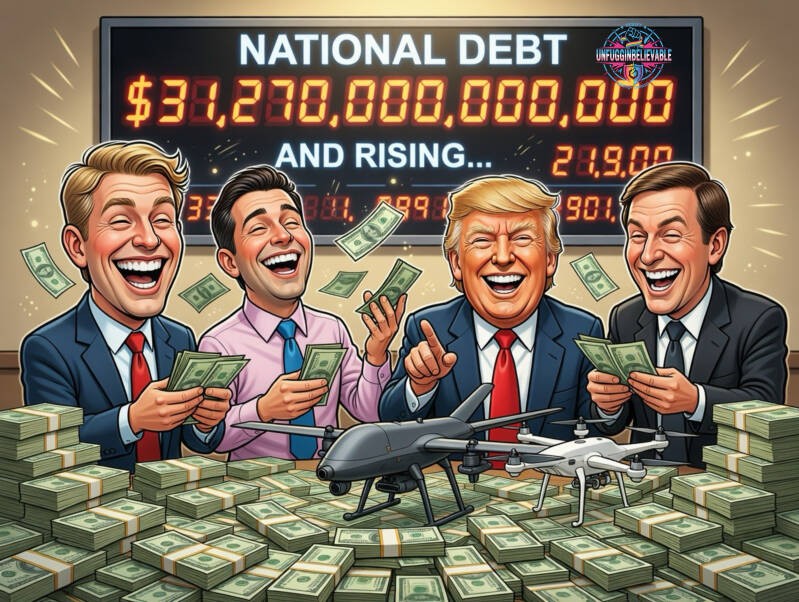
As of April 30th, the national debt officially crossed 100 percent of GDP for the first time since the aftermath of World War II. The number is staggering enough on its own: $31.27 trillion in debt held by the public against a $31.22 trillion economy, a grim milestone the Committee for a Responsible Federal Budget called “headed toward uncharted territory.” But unlike 1946, when that debt ceiling was hit financing the largest military mobilization in American history, today’s version comes with a twist: somebody in the family is making money off of it.
The Iran war -“Operation Epic Fury” - in the branding of an administration that apparently named it while watching a trailer for a movie they’d never seen, has been burning through American taxpayer money at a pace that would make a drunken defense contractor blush. Estimates from the Penn Wharton Budget Model put the daily tab at around $800 million to $1 billion. The American Enterprise Institute calculates costs had already surpassed $35 billion by April 1st. Harvard Kennedy School’s Linda Bilmes, one of the foremost public finance experts in the country, says the true costs are at least double the Pentagon’s reported figures; because the Pentagon, in its charming tradition, prices munitions at historical inventory value rather than what it actually costs to replace them in 2026. When you account for long-term veteran disability benefits, infrastructure rebuilding, and compounding interest on the debt we’re borrowing at record rates to fund this, Bilmes says the war could top $1 trillion. Total. And that’s before Kegsbreath went to Congress and asked for a $1.5 trillion Pentagon budget for fiscal year 2027—a 44 percent increase from the prior year—plus a separate $200 billion war supplemental to keep Operation Epic Fury operating at full Fury.
Meanwhile, the government is currently spending $1.33 for every dollar it collects in revenue, running a deficit projected at $1.9 trillion this year, and paying nearly $1 trillion annually in interest alone. One in seven dollars of the entire federal budget goes toward debt service. Not defense. Not healthcare. Not roads or schools or food assistance. Interest. Just the carrying cost of the national credit card, now maxed out past the size of the economy itself.
If you drove to work this week, you already know your share of that cost. The national average for a gallon of gas hit $4.39 on May 1st, up roughly 50 percent - nearly $1.50 per gallon -since before the first missile landed in Tehran on February 28th. A key inflation gauge jumped 3.5 percent year-over-year in March, the highest in nearly three years, driven almost entirely by energy prices. The Federal Reserve’s preferred measure, the PCE index, could hit 4 percent by year’s end, double its target rate. Groceries cost more, because diesel costs more, because Brent crude surged more than 50 percent in the weeks after the Strait of Hormuz closed, cutting off roughly one-fifth of the world’s oil and gas supply. Your spring break flights cost more. Your utility bills cost more. Anything that gets put on a truck costs more. And your wages? According to the Commerce Department’s latest report, income grew 0.6 percent last month—slower than inflation, for the second straight month. So you’re making less in real terms while paying more for everything. That’s the math. That’s the war tax.
But don’t worry, the president has a message for you. When asked about rising gas prices, Trump said, and we quote: “If they rise, they rise.”
Great. Thanks, Taco.
Now. Let’s talk about the people for whom prices rising is, in fact, a very good thing.
Donald Trump Jr. and Eric Trump joined the board of a drone company called Powerus after a golf club holding company they’d backed merged with it in March to take it public. Powerus, founded in 2025, is based in West Palm Beach (home of Trump International Golf Club), because of course it is. The financial scaffolding runs through American Venture Partners, which is also backed by Dominari Holdings, a fintech and securities group operating out of Trump Tower. On April 30th, Bloomberg reported that the U.S. Air Force signed a weapons deal to buy an undisclosed number of interceptor drones from Powerus for deployment in the very war their father launched without a congressional vote. The contract value has not been disclosed. The number of drones has not been disclosed. The competitive bidding process has not been disclosed. What has been disclosed is that former Lieutenant General Keith Kellogg, Trump’s special envoy for Ukraine and Russia, sits on Powerus’s advisory board. Also: the drones are called the Guardian-2. An interceptor drone. Built to shoot down the same cheap Iranian attack drones that are buzzing around the Gulf and killing American service members. Drones that exist in abundance because the war continues. A war the president started.
Former White House ethics lawyer Richard Painter, who served under George W. Bush and cannot be accused of being a partisan Democrat, put it with clarifying bluntness: “This is going to be the first family of a president to make a lot of money off war - a war he didn’t get the consent of Congress for.” He also noted that Gulf states are under “enormous pressure to buy from the sons of the president so he will do what they want.” In the same week, Eric Trump publicly celebrated a separate $24 million defense contract won by Foundation Industries, another company where he serves as chief strategic adviser, which builds AI-driven humanoid robots for military use. And the Pentagon awarded a contract worth up to $20 billion to Anduril Industries, Inc., which counts Joshua Kushner, Jared’s brother, as a major funder. The Kushner family is having quite a fiscal quarter.
Speaking of Jared. Creepy, helium voiced Jared… In a functional democracy, the chief diplomatic envoy handling a nuclear war negotiation would be—at minimum—someone who has read a book about the country in question, spoken to a diplomat before, or held some government role that didn’t involve property development. The Joint Comprehensive Plan of Action - the JCPOA, the nuclear deal Trump blew up in 2018 because Obama made it - took twenty months of negotiations. It involved career diplomats with decades of institutional knowledge. It required nuclear physicists, IAEA verification experts, legal specialists who could parse every ambiguous word in a 160-page technical document across multiple languages, and the coordinated participation of China, Russia, France, the UK, Germany, the EU, and the United States. The Iranian delegation in 2015 included their chief negotiator Abbas Araghchi, who holds a doctorate in political thought from the University of Kent and spent his entire career inside every major nuclear negotiation Iran has ever conducted. He was back at the table in 2025 and 2026, and he’s still there.
The American delegation in 2025 and 2026 featured Steve Witkoff, a New York real estate developer, and Jared Kushner, a New Jersey real estate heir who once told a Lex Fridman podcast that when he arrived at Middle East negotiations, he told previous envoys, “I don’t need a headache, and I don’t need a history lesson.” He wanted, as he put it, “a very simple thing.” How diplomatic. How refreshing. What could possibly go wrong when a guy who doesn’t want a history lesson sits down across from people who have been running nuclear policy since before he was born.
Career diplomats who watched the negotiations described the American approach to the Asia Times as “presenting demands and waiting for surrender,” rather than the painstaking horse-trading that produced the 160-page JCPOA. Aaron David Miller, who advised six secretaries of state, said Kushner and Witkoff showed “little willingness to confront” the president with the consequences of maximalist demands. Former lead JCPOA negotiator Wendy Sherman told NPR flatly: “You cannot do a negotiation with Iran in one day. You can’t even do it in a week.” And she would know, she spent eighteen months doing the last one. Sources speaking to Al Majalla reported that Kushner’s presence in Islamabad actually undermined the talks, with Iran able to build rapport with JD Vance before sensing that Kushner’s hands were on the wheel and Vance’s were tied. After twenty-one hours, the talks collapsed. Vance announced Iran was “not prepared to accept our demands.” Witkoff, in an interview shortly before the war began, was reportedly “astonished” that Iran hadn’t simply capitulated. To American demands. To the same president who blew up the last deal. You genuinely cannot make this up.
But let’s be honest about why Jared Kushner is in the room, and it has very little to do with his commitment to international peace. According to a regulatory filing from March, Kushner’s investment firm Affinity Partners reported more than $6.1 billion in assets, with roughly 99 percent of those assets belonging to non-U.S. investors, the overwhelming majority tied to Saudi Arabia, the United Arab Emirates, and Qatar. Saudi Arabia’s sovereign wealth fund alone invested $2 billion into Affinity. The Senate Finance Committee estimates Kushner will be paid $137 million in management fees from that Saudi fund through August 2026 alone. In March, the New York Times reported that Kushner was simultaneously holding talks with Saudis and Gulf states about raising an additional $5 billion or more for Affinity Partners—while serving as one of the president’s lead envoys in a war with Iran. A war that Saudi Crown Prince Mohammed bin Salman reportedly lobbied Trump to start. The same MBS who made the Saudi sovereign wealth fund invest $2 billion in Jared’s company. CNN reported that both Saudi Arabia and the UAE lobbied Trump to strike Iran. The UAE is also a major backer of Affinity Partners, directly investing about $200 million. Reconstruction contracts in the aftermath of a war could be worth billions more.
Citizens for Responsibility and Ethics in Washington sent a public letter to the White House demanding Kushner file the financial disclosure reports required of government employees. The White House response was that Kushner is “generously volunteering his time.” He is, in the technical sense, a volunteer. A volunteer who will collect $137 million from Saudi Arabia’s sovereign wealth fund this year. The most lucrative volunteer in the history of charitable endeavors.
And then there’s the insider trading question. Axios reported in late March that $580 million in oil futures flooded the market roughly sixteen minutes before Trump announced a pause in strikes on Iranian power plants—with no public news to explain the surge. The New York Times reported an unusual surge of more than 150 Polymarket accounts placing hundreds of bets predicting a U.S. strike on Iran by the next day—the day before it happened. This pattern has become, as Axios noted, “impossible to ignore,” spanning both traditional financial markets and prediction platforms, echoing similar anomalies around Trump’s “Liberation Day” tariff pause in 2025. The White House called the suggestion of insider trading “baseless and irresponsible.” The $580 million in perfectly timed oil futures had no comment.
The Trump Organization also, let’s recall, inked a $7 billion hotel and golf development deal in Saudi Arabia, funded entirely by the Saudi sovereign wealth fund, weeks before the war began. Five hundred mansions priced between $6.7 million and $24 million each, in a development called Diriyah, built on $63 billion in PIF money. The same PIF that’s paying Jared Kushner $137 million. The same Saudi government that reportedly pushed Trump into the war. It is not a conspiracy theory to note that the president, his sons, his son-in-law, and his son-in-law’s brother are all making extraordinary sums of money from a war the president started, sustained, and has not yet ended. It is, in fact, just reading the news.
Back in the real world - the one where you live - consumer sentiment dropped to its lowest recorded level in April. Americans’ real incomes are falling behind inflation for the second straight month. The “Big Beautiful Bill” already cut food assistance for millions while extending tax cuts for the wealthy. The same Congress that can’t muster the votes to invoke the War Powers Resolution is being asked to sign off on $200 billion in additional war spending and a $1.5 trillion defense budget. Harvard’s Linda Bilmes notes that before this war started, the U.S. already owed $7.3 trillion in future veteran disability benefits from previous wars, and now we’re adding more. We’re borrowing at higher rates, on top of a larger debt base, to fund a war with no defined end state, no congressional authorization, and no diplomatic team with the expertise, independence, or incentive to end it.
That last part is worth sitting with. The people negotiating the peace are invested in the continuation of the war. The sons selling drones need Iranian attack drones to keep flying. The son-in-law raising billions from Gulf states needs those Gulf states to keep needing American protection. The reconstruction deals don’t materialize until there’s rubble to rebuild. The incentives here are not aligned with an end to hostilities. They are aligned, quite precisely, with the war going on as long as possible.
Sixty days in. Over $25 billion spent by the Pentagon’s own conservative accounting. A billion dollars a day by most independent estimates. The national debt larger than the economy for the first time since 1946. Gas at $4.39 a gallon and climbing. Inflation at a three-year high. Real wages falling. And the Trump sons are on the board of a drone company. And Jared Kushner is raising billions from the countries that wanted this war. And someone moved $580 million in oil futures sixteen minutes before the president made an announcement.
They told you it was about Iran’s nuclear program. The same nuclear program the administration said it “completely obliterated” in the June 2025 strikes—and then, ten months later, used as justification to start a whole new war. When Rep. Adam Smith pressed Hegseth on this contradiction under oath, Hegseth said Iran “had not given up their nuclear ambitions.” Ambitions. Not weapons. Not enriched stockpiles about to be weaponized. Ambitions. We are spending a billion dollars a day, borrowing against your children’s future, to confront an ambition. While Junior counts his drone money.
The JCPOA wasn’t perfect. No arms control agreement is. But it was a 160-page, meticulously negotiated, internationally verified framework built by career diplomats, nuclear scientists, and legal experts over twenty months. It worked—until the man now running this war blew it up in 2018 because it had Barack Obama’s name on it. And now, eight years later, instead of rebuilding something like it with people who know what they’re doing, we have Jared Kushner at the table telling the Iranians he doesn’t need a history lesson, while simultaneously texting the Saudis about his next fund raise.
You are paying for this. Every trip to the grocery store. Every fill-up. Every utility bill. Every dollar of interest on a debt that now exceeds the size of the entire American economy. You are paying for it so that the president’s sons can sell drones to the Air Force and the president’s son-in-law can collect management fees from the governments that lobbied for the war. There is a word for this arrangement. It is not “national security.” It is not “strategic interests.” It is not even, in the euphemistic Washington tradition, “conflicts of interest.”
It’s a racket. And you’re the mark.
—
**If this work matters to you, you can support it at buymeacoffee.com/unfugginbelievable. Independent journalism runs on reader support, not ad revenue. Every cup keeps the lights on and the snark flying.
Add comment
Comments