

Before the first missile hit Iranian soil on February 28th, 2026, there was a phone call: Benjamin Netanyahu called Donald Trump on February 23rd, five days before the bombs fell, to tell him the exact location of Supreme Leader Ali Khamenei’s upcoming meeting with his top advisors. He knew the meeting. He knew the location. He had the intelligence. What he needed was the green light. Trump gave it. Five days later, in the darkness before dawn, more than five hundred strikes hit Iran simultaneously. The Supreme Leader was killed in the first hours. The war Bibi had spent eighteen years of his political career working toward had finally arrived, because a US president was finally crazy enough to join him.
Der Spiegel, Germany’s most widely read news magazine, called it plainly: a dream for Benjamin Netanyahu that became true.
This piece is about that dream. About who dreamed it with him. About who is winning now that it has become real. And about what it cost to make it happen — not in dollars, though the dollars are staggering, but in the things that the dollars were standing in for. The institutions. The laws. The wall.
Netanyahu has made regime change in Iran the central theme of his political career since at least the late 1990s. He told the United States Congress in 2002 that removing Saddam Hussein would have enormous positive reverberations in the region, that it would also hasten the fall of other terrorist regimes. He was wrong about Iraq and he knew he was wrong, and he said it anyway, and the people who trusted him paid for it in twenty years of war and four thousand four hundred and ninety-one American dead. He spent the next two decades positioning himself as the Winston Churchill of the Middle East, warning anyone who would listen that Iran was 1938 all over again, that the mullahs were Hitler, that time was running out. He was laughed at in some diplomatic circles and taken seriously in others. He needed a president who would take him seriously enough to act.
He found one.
But Netanyahu did not find Hair Führer alone. He found him with help — from a network of American Christians who have been praying, literally and on the record, for exactly this war for decades. Not praying for peace. Praying for this. For the bombs. For the fire. For what comes after.
This requires explanation, because most Americans have never heard of dispensationalism and have no idea what Christian Zionism actually teaches. They assume — reasonably — that American Christians who support Israel do so because they admire Israeli democracy, because they feel historical solidarity after the Holocaust, because they believe in the right of the Jewish people to self-determination. Some do. But for the most influential evangelical voices in the Trump movement, the support for Israel has nothing to do with any of those things. It has to do with what happens to Jewish people after the war.
In the dispensationalist theological framework — the one that produced the Left Behind novels, that fills megachurches every Sunday, that has representatives in the Cabinet and on the National Security Council — the return of Jewish people to Israel is not the end of the story. It is the setup. The end of the story is the Second Coming of Jesus Christ. And the Second Coming requires a sequence of events, one of which is a catastrophic war in the Middle East — the battle of Armageddon, fought at Megiddo in Israel — that will kill most of the people on earth before Jesus arrives to establish a thousand-year kingdom. Most of the Jewish people alive during this battle will also die. The survivors will convert to Christianity. This is the end point of the theology. Not a Jewish homeland. A Christian world, built on the ruins of everyone else’s.
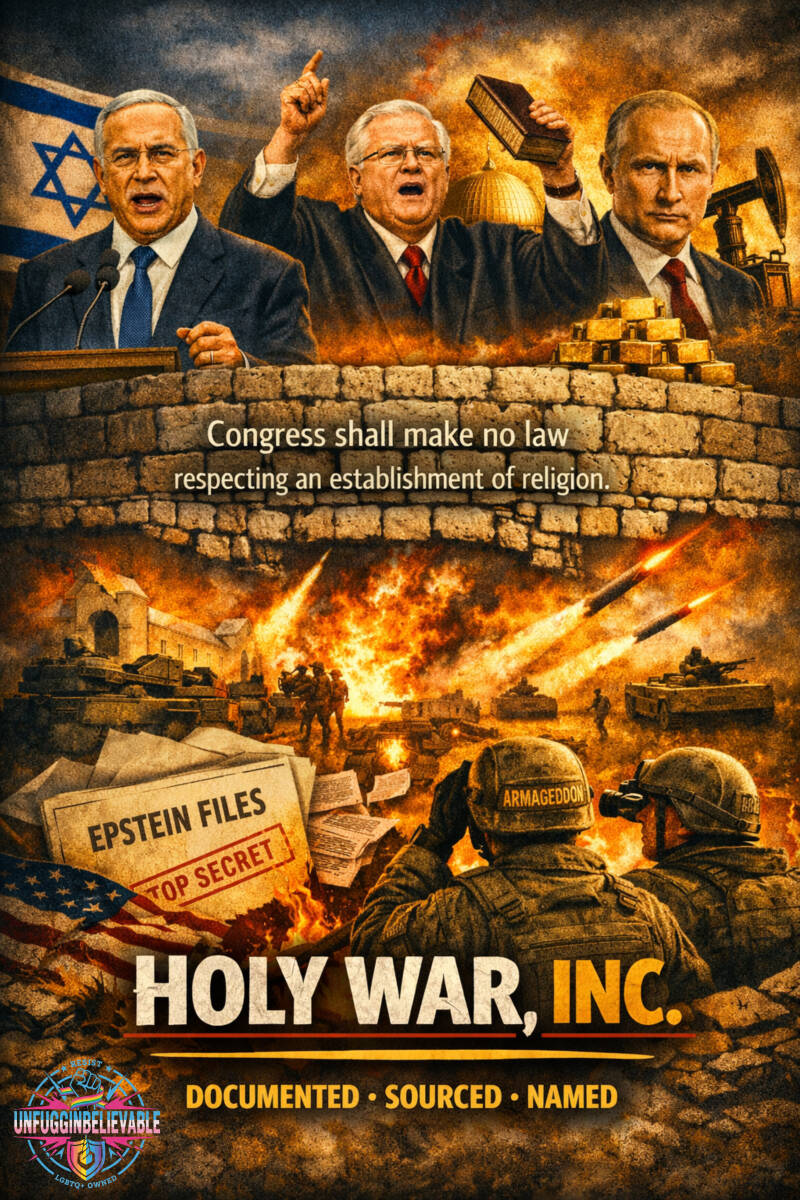
This is not a fringe interpretation. This is the mainstream of the American evangelical political movement that helped elect Donald Trump, twice. John Hagee, the founder of Christians United for Israel — the largest pro-Israel organization in the United States with ten million members — delivered a sermon on March 1st, 2026, three days after the bombs started falling, and described the war as part of a divine plan. His exact words: “Prophetically, we’re right on cue.” He then prayed that God Almighty be brought onto the battlefield and that the enemies of Zion be destroyed before our eyes. Hagee has stood in front of a mural depicting the Book of Revelation and described Armageddon as the most bloody battle ever recorded in the history of the world, after which there will be one king and one leader — Jesus Christ — and one law: his law. No presidential elections. No fake news. One law. His law.
In the run-up to the attack on Iran, Hagee told Fox News that Trump was uniquely suited to pursue a biblically mandated policy of cutting down Israel’s enemies. Ambassador to Israel Mike Huckabee, a Baptist minister who has been leading Holy Land tours to Israel for years, told an interviewer he believes it would be fine if Israel took over the Middle East. That is the United States Ambassador to Israel. Telling an interviewer. On camera. That Israeli domination of the entire region would be fine.
And then there are the people in uniform who were told this war was God’s plan.
Since the strikes began, the Military Religious Freedom Foundation has received more than two hundred complaints from service members across every branch of the military, across more than forty units, in at least thirty installations. The complaints describe commanders telling troops that the war with Iran was part of a divine plan. That it was biblically sanctioned. That it was a step toward the end times. An unnamed noncommissioned officer wrote to the foundation that a commander had told officers to tell their troops that this was all part of God’s divine plan, citing specific passages from the Book of Revelation about Armageddon. The same officer reported that the commander told the unit that Trump had been anointed by Jesus to light the signal fire in Iran to cause Armageddon and mark his return to Earth.
These are not anonymous internet posts. These are documented complaints from active duty service members filed with a nonprofit watchdog organization that has been tracking military religious freedom violations since 2005 and has the legal infrastructure to verify them. Two hundred complaints. Forty units. Thirty installations. Every branch.
This is the wall coming down in the place where the consequences are most immediate and most lethal. The military is not supposed to be a crusading theological movement. It is a professional defense force that operates under civilian oversight, international law, and the Constitution of the United States. When commanders tell service members they are fighting for God’s plan rather than for national security objectives that can be evaluated, questioned, and held accountable — they are removing the institutional architecture that makes accountability possible. You cannot court-martial a divine mandate. You cannot subpoena God.
Now. Hold all of that. Hold Netanyahu’s eighteen-year project. Hold Hagee’s sermon. Hold the two hundred complaints from service members. Hold the anointed president and the signal fire and the dream of Armageddon. And ask yourself who else is in the room.
Vladimir Putin is in the room.
Russia’s Urals crude was trading at forty dollars a barrel in late February, battered by Western sanctions and the longest sustained economic pressure campaign since the Cold War. Putin had been watching his war chest drain. Ukraine was grinding on. The costs were enormous. And then the bombs fell on Iran, and the Strait of Hormuz effectively closed, and oil prices hit a hundred dollars a barrel for the first time since Russia’s full-scale invasion of Ukraine in 2022. Russia ships 3.26 million barrels of crude per day. At a hundred dollars a barrel, with sanctions being actively unwound, the math is not complicated. The European Council president, António Costa, said it with a precision that deserves to be quoted directly: so far, there is only one winner in this war — Russia.
And then Trump lifted the sanctions.
Not because Russia had done anything to earn it. Not as part of a negotiated agreement. Not in exchange for a single concession on Ukraine. Because oil prices were spiking and the administration needed supply and Putin had oil and Trump had just spent fifteen minutes on the phone with him. The sanctions that had been imposed because Russia invaded a sovereign democracy, that had been the primary economic tool of Western pressure on Moscow’s war machine, were lifted. Temporarily, the Treasury Secretary said, until April 11th. Russia welcomed the move and immediately pushed for more. Ukraine’s president called it not the right decision and said it would strengthen Russia’s position. European leaders called it very concerning. Senator Jeanne Shaheen said what the documented facts demanded: as Putin helps Iran target Americans in the Middle East, the President is filling the Kremlin’s war coffers.
Putin told Russian energy producers to make use of the current moment. They are making use of it. The longer the war lasts — the longer the Strait of Hormuz stays closed, the longer oil stays above a hundred dollars, the longer American attention and military resources are pointed at the Middle East instead of Eastern Europe — the more money flows into the Russian war machine, and the less pressure there is on Moscow to negotiate anything at all about Ukraine.
A fractured world, like a fractured country, is this administration’s preferred operating environment.
And then there is the other room. The one nobody wants to say out loud.
On January 30th, 2026, a new batch of Epstein-related documents was released. The documents implicated figures across multiple governments. Several senior officials resigned. Howard Lutnick, the Secretary of Commerce, agreed to give testimony to lawmakers about his ties to the disgraced financier. A congressional commission and multiple federal judges were reported to have access to further unredacted files in which Trump’s name appears thousands of times. Four weeks later, on February 28th, the bombs fell on Iran. Google searches for the Epstein files collapsed that day. They have not recovered. The war took up Congress’s time. The war took up the media’s time. The war took up everything.
Republican Congressman Thomas Massie said on the floor of the House that the war would not make the Epstein files go away. He was right. But it did make them disappear from the first page of every newspaper in the world for the two weeks that mattered most.
We are not saying the war was started to bury the Epstein files. We are saying that a man facing the potential public exposure of a congressional investigation into his connections to a convicted sex trafficker started a war four weeks after the most damaging document release yet, and that Google searches for those documents collapsed the day the bombs fell, and that polling showed only 21 percent of Americans supported the strikes before they happened, and that the president’s approval numbers were the worst of his term, and that the economy was contracting, and that he had campaigned on no new wars, and that he has moved the goalposts on what this war is for at least four times since it started.
We are saying all of that, sourced, and we are leaving the conclusion to you. That is what the documented facts require.
Here is what is also documented, and what the series has been building toward since Piece One: this war did not happen in a vacuum. It happened after decades of dismantling the wall between church and state. After filling the judiciary with judges selected for their views on religious liberty. After placing Christian nationalists in every cabinet seat that touches foreign policy and military power. After a pastor prayed in the Pentagon auditorium that God be brought onto the battlefield. After commanders told service members they were fighting for the Second Coming.
The wall was supposed to make this impossible. A government with a load-bearing wall between its authority and any theological mandate cannot declare holy war. It cannot tell its soldiers they are fighting for God. It cannot let a pastor with a prayer for Armageddon shape the foreign policy of the most powerful military on earth. The wall was not decorative. It was the architecture that prevented the state from doing this.
The wall is gone.
And the dream is real.
Piece Five is the last piece. It is about what all of this costs — not the people already named, but every person in this country regardless of faith, regardless of politics, regardless of whether they ever cared about any of this until the price of gas hit five dollars and their kid came home in a flag-draped transfer case. It is about what is left of the architecture. And about whether any of it can be rebuilt.
Add comment
Comments