

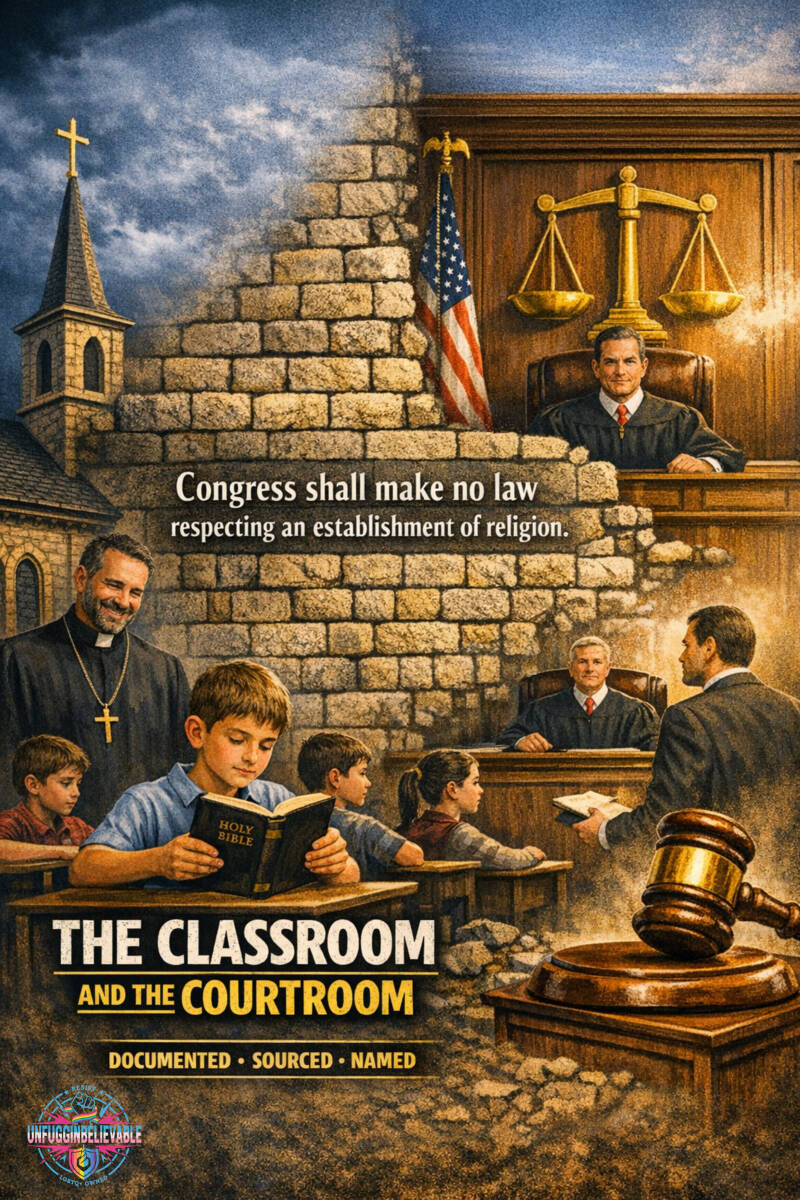
They started with the children... Not because they are cruel — though the outcomes are cruel — but because they are strategic. Children cannot vote. Children cannot sue. Children cannot walk out of a classroom where the government has decided their conscience is up for grabs. Children are a captive audience, and the people who have been systematically dismantling the wall between church and state have understood that from the beginning. You do not transform a nation by persuading the adults who already have their convictions. You transform a nation by getting to the children first, in the rooms where they are required by law to be present, before they have the vocabulary to name what is being done to them.
This is Piece Two. This is where the project moved off the whiteboard and into the building.
The classroom offensive did not arrive without warning. It was telegraphed openly, in legislation, in state superintendents’ press releases, in governors signing bills at Catholic schools while photographers captured the moment for the evening news. Louisiana Governor Jeff Landry signed his state’s Ten Commandments bill at Our Lady of Fatima Catholic School. He told reporters: if you want to respect the rule of law, you’ve got to start from the original law giver, which was Moses. That is not a dog whistle. That is a PA system.
What Louisiana passed in 2024 was a law requiring poster-sized displays of the Ten Commandments — a specific Protestant King James Bible version — in every public school classroom in the state, from kindergarten through college. Not suggested. Required. Eleven by fourteen inches minimum, large readable font, the text as the central focus. Multi-faith families — Jewish, Catholic, Unitarian, nonreligious — sued immediately. Their complaint described children sitting in classrooms where the government had posted its preferred religious scripture on the wall and told them this is the foundation of law. A federal judge called it unconstitutional on its face. A three-judge appeals panel struck it down unanimously, citing a Supreme Court precedent that had already settled this exact question in 1980. Louisiana’s attorney general announced she would appeal it to the Supreme Court if necessary.
And then, three weeks ago, a different panel of the same appeals court — this one composed of judges appointed by Republican presidents, in a court where Republican-appointed judges outnumber Democratic-appointed ones more than two to one — voted twelve to six to let the law take effect while the litigation continues. The Ten Commandments are going up. The legal battle is ongoing. The 1980 precedent, cited by Harvard legal scholars as settled law, is now unsettled. One Harvard professor, asked directly whether the old standard still holds, said with this Court, nothing is settled. Roe v Wade was settled law too.
Louisiana was not alone and was not first. Oklahoma’s then-superintendent of public instruction Ryan Walters — a man who once stood at a state board meeting and declared that you’re not going to find the separation of church and state in the Constitution — announced in 2024 that all public schools in his state would be required to teach the Bible in grades five through twelve. He said immediate and strict compliance was expected. He purchased 500 King James Bibles with state funds for AP Government classes and requested three million dollars more from the legislature for additional classroom copies. When educators pushed back, he threatened to fire anyone who refused to comply. At least eight school districts publicly stated they would not alter their curriculum. The Oklahoma Supreme Court temporarily blocked him from spending state funds on the purchase of Bibles with specific religious characteristics. Walters was eventually removed from office — but not before he had assembled a committee to review Oklahoma’s social studies standards that included, as an invited expert, David Barton. The same discredited pseudo-historian from Piece One. The wall comes down in layers, and the same hands keep appearing.
Texas began infusing an optional Bible curriculum into public schools using private funds. Florida, Louisiana, and Texas passed laws allowing or requiring schools to bring in religious chaplains as student counselors — with Texas and Louisiana including no prohibition against those chaplains using their access to students to evangelize. Thirteen other states introduced similar chaplain bills. In 2024 alone, Republican and Democratic legislators across the country introduced more than 650 bills tied to religion in education. PragerU — not a university, a conservative media organization founded by a talk radio host, whose videos feature guests claiming the founders never intended church and state to be separate — was approved as an educational vendor in six states: Florida, Oklahoma, Texas, New Hampshire, Montana, and Arizona. These are not rogue school board decisions. These are state-level policy. These are the playbook’s intermediate steps arriving at scale.
And then there is the money.
Vouchers — government funds that families can use to pay tuition at private schools — have existed in limited forms for decades. In the past four years they have exploded. Since 2021, nearly a dozen states have passed universal or near-universal school choice policies. Billions of taxpayer dollars are now flowing annually into private schools. The vast majority of those private schools are religious. In Florida, which has the largest voucher program in the country at more than three billion dollars per year, at least 82 percent of voucher students attend religious schools. In Arizona, 87 percent of voucher tuition money goes to religious institutions. In state after state, the pattern is the same: expand the program, watch the money flow to religious education, and watch the public school budget shrink to cover the gap.
This is not an accident. The Supreme Court cleared the way for it, ruling in 2020 that states could not exclude religious schools from voucher programs available to secular private schools — a ruling that effectively made public funding of religious education not just permissible but, in some interpretations, required. The school choice movement had spent thirty years and hundreds of millions of dollars in lobbying, litigation, and legislative strategy to reach that decision. When it came, the tap opened. A Columbia University education researcher described the outcome plainly: enrollment growth in religious schools is a chief outcome of this expansion of vouchers. This should come as no surprise.
What should surprise you — what should stop you cold — is the scale of what is being defunded to pay for it. Every dollar that follows a voucher student out of a public school district is a dollar that does not go to the children left behind. Rural school districts, which serve about twenty percent of America’s public school students and have already been forced to merge, cut programs, and in some cases shut down entirely, face the sharpest cuts. The children most likely to be left in those thinning public schools are the ones whose families cannot navigate a private school application, whose disabilities require services a religious school is not required to provide, whose identities make them unwelcome in institutions that are now, with public funds, legally permitted to discriminate. The wall between church and state was not only a protection for conscience. It was a protection for those children. It is being sold for vouchers.
And the courtroom has been rewired to let it happen.
In Piece One we described the Supreme Court’s 2022 decision in Kennedy v. Bremerton, which threw out fifty years of establishment clause analysis and replaced it with a vague instruction to consult historical practices. The effects of that decision are still cascading through lower courts, which are now trying to adjudicate establishment clause claims without a consistent legal standard. In that same term, the Court ruled that states could not exclude religious schools from tuition assistance programs. The following year, in 303 Creative, the Court ruled that a business owner could refuse service to customers whose lives conflicted with her religious beliefs. Each case built on the last. Each one moved more public money, more public space, more public authority toward one specific tradition and away from every other one and from those with none at all.
The Court came within one recusal of crossing the next threshold. In 2025, the justices deadlocked four to four on whether Oklahoma could open the nation’s first taxpayer-funded religious charter school — a Catholic school that would have operated as a public school in name while serving explicitly as, in the school’s own words, a genuine instrument of the church. The deciding vote was willing Handmaid Amy Coney Barrett, who recused herself because her close friend at Notre Dame Law School was representing the school. The charter was blocked — for now — but legal scholars are unanimous on one point: this question is coming back. When it does, Barrett will almost certainly participate, and the votes are there. The question is not whether publicly funded religious schools will exist. The question is when.
That is what the classroom offensive has bought: a generation of children educated at public expense in institutions that are not required to include them all, not required to meet uniform academic standards, and not prohibited from telling them what God requires. And a legal infrastructure that is no longer equipped to stop it.
The classroom was just the beginning. In Piece Three, the project moves into the machinery of government itself — the agencies, the Pentagon, and the podium where a Secretary of Defense quotes scripture over the bodies of the dead.
Add comment
Comments