

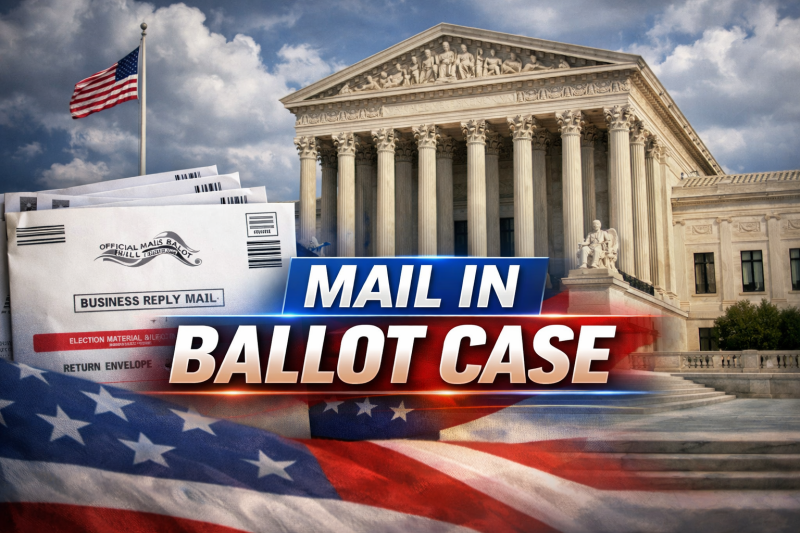
Today — March 23, 2026 — the Supreme Court of the United States is hearing oral arguments in Watson v. Republican National Committee, a case that has the power to strip the vote from millions of Americans before November’s midterms. The RNC, with the full weight of the Trump administration filing alongside them, wants the court to declare that any mail ballot not physically in the hands of an election official by the close of Election Day should be thrown out. It doesn’t matter if you mailed it in time. It doesn’t matter if it was postmarked on Election Day. It doesn’t matter if the postal service delayed it. It doesn’t matter if you’re a deployed soldier in Japan, an elderly voter in a rural county without a drop box, or a wheelchair-bound American who entrusted the U.S. mail with the only vote they had. If it’s late, it’s gone.
Let’s be precise about what this is, because the RNC would very much like you not to be.
The case centers on Mississippi’s law allowing mail ballots to be counted if they arrive up to five days after Election Day — as long as they were postmarked on or before Election Day. Thirty states, the District of Columbia, and several U.S. territories have similar grace period laws. These laws exist because mail takes time. They exist because the postal service is not a guaranteed same-day service. They exist because we have, as a country, made a collective decision that a ballot cast on time should be a ballot that counts — regardless of when a letter carrier gets it to the door.
The RNC sued Mississippi to end that.
The U.S. Court of Appeals for the 5th Circuit — reliably among the most conservative federal circuits in the country — handed them a win, ruling that federal election statutes require ballots to be received, not just cast, by Election Day. Mississippi appealed to the Supreme Court. The Trump administration, not a party to the case, filed an amicus brief supporting the RNC anyway. Solicitor General John Sauer argued that keeping ballot boxes open after Election Day invites fraud and undermines confidence.
What he did not offer was evidence.
That’s because the evidence doesn’t exist. The Republican Party’s fraud argument is a ghost story, and they’ve been telling it so long that some people have started decorating for Halloween year-round.
Here are the actual numbers. The Associated Press spent months investigating voter fraud claims in the six battleground states Donald Trump disputed after the 2020 election — the same states where his allies screamed the loudest. They examined roughly 25 million votes. They found fewer than 475 potential instances of voter fraud. Those instances were scattered across both parties, almost always caught before the votes were counted, and not remotely close to affecting any outcome. The Heritage Foundation — a right-wing think tank, not a source friendly to this argument — has been compiling its own database of election fraud cases for decades. Across billions of ballots cast, they found roughly 1,325 total convictions. In 40 years. In the entire country.
Donald Trump alone has 34 felony convictions.
Let that sit for a second. The man leading the national campaign to eliminate mail-in voting on the grounds that it enables fraud has personally racked up more felony convictions than the Heritage Foundation’s fraud database averages per year. He was found guilty by a jury of falsifying business records — 34 separate counts — to conceal a hush money payment designed to corrupt the 2016 election. That’s not a talking point. That’s a verdict.
And the people he’s trying to protect the ballot from? Let’s name them.
Nearly four million U.S. servicemembers and citizens living abroad rely on mail ballots to vote. They can’t go stand in line at their polling place in Ohio. They’re stationed in Japan. They’re deployed in Germany. They’re working at embassies in Kenya and Vietnam, and their mail can take six to eight weeks to arrive. During the 2024 Texas primary, a military couple in Germany mailed their ballots three weeks before the election. They arrived the day after Election Day. Under the rule the RNC is asking the Supreme Court to impose, those ballots don’t count. The people who wore the uniform don’t get a vote — because the USPS couldn’t keep the schedule that the Republican Party decided should disqualify them.
Then there are the seniors. The voters with disabilities. The people in rural states like Mississippi, which has banned ballot drop boxes, meaning the only way to return a mail ballot is through the postal service. There are no alternatives. You cast your ballot, you mail it, and then it is entirely out of your hands. And if a delay at a postal processing center costs you a day, the RNC wants that ballot in the trash.
This would not be a small disruption. Washington state’s director of elections said that if the Supreme Court rules against grace periods, roughly 127,000 ballots cast in 2024 alone would have been rejected. In Washington state. In one election. That’s not a rounding error. That’s a constituency. Illinois accepts mail ballots received up to two weeks after Election Day. California, seven days. If the court rules broadly, both of those laws are gone — with five months until the midterms.
Five months.
A ruling is expected by the end of June or early July. That means election officials in over two dozen states will need to rewrite voter education materials, change their procedures, notify millions of voters about new deadlines, and hope that all of this penetrates before November — in a year when control of the House and Senate is on the line. Democratic election attorney Marc Elias, who represents several parties defending Mississippi’s law, put it plainly: this is a partisan effort to undermine mail-in voting. Not because mail-in voting is vulnerable to fraud — it isn’t, not at any scale that would register — but because voting by mail skews Democratic, and the RNC said so themselves in their own court filings.
Let’s say that again for the back: the Republican National Committee acknowledged in their legal briefs that mail-in voting is “starkly polarized by party” and that it disadvantages Republicans. Then they sued to eliminate it. They said the quiet part so loudly that it echoed off the Supreme Court’s marble walls.
This is not about election integrity. The integrity of American elections is documented, litigated, audited, and certified. It survived 2020, two impeachments, a coordinated disinformation campaign, sixty-plus failed lawsuits, and a sitting attorney general who told the president his own DOJ found no evidence of widespread fraud. Voter fraud is, in the words of researchers who have examined billions of ballots over decades, “infinitesimally rare.” It almost never occurs at a scale that would affect any outcome, anywhere.
What does affect outcomes is turnout. Who shows up. Who gets counted.
And that is exactly what this case is about.
The court has three other election-related cases this term — one challenging limits on coordinated campaign spending, one on race-based redistricting that could further gut the Voting Rights Act, and this one. Taken together, they represent an aggressive restructuring of how elections function in this country, pursued through courts rather than legislatures, by a party that has decided it cannot win if everyone is allowed to vote.
That is not a conspiracy theory. It is a legal strategy.
They filed it. They briefed it. They argued it. Today, they asked six Republican-appointed justices to make it permanent.
We have five months.
Add comment
Comments