

Four days into a war that nobody voted for, nobody fully understands, and nobody in the administration can explain the same way twice, the bombs are still falling on Iran — and the story being sold to the American people keeps changing faster than the targets.
Let’s start with what we know is actually happening on the ground, because the human cost of this chaos deserves to be stated plainly before we wade into the spectacular mess of contradictions pouring out of this regime.
The U.S. and Israel pounded Iran through the night again. By Tuesday morning, U.S. Central Command confirmed strikes against more than 1,700 targets since operations began Saturday — Iranian naval ships, submarines, anti-ship missile sites, command and control centers. Trump claimed from the Oval Office that Iran now has “no navy, no air force, no air detection, no radar.” Whether or not you believe that, the retaliation has been broad, ferocious, and spreading in ways the administration is now admitting it did not see coming.
Iran didn’t just hit back at Israel. It hit back at everyone.
Lebanon’s Health Ministry reported at least 52 killed and 154 wounded in overnight strikes on Beirut’s suburbs and southern neighborhoods. Iran launched fresh missile barrages on central Israel, wounding civilians in residential areas. The U.N. confirmed damage to a nuclear facility inside Iran for the first time since operations began — raising its own set of alarming questions that nobody in Washington seems eager to answer. The U.S. Embassy in Saudi Arabia was struck by drones. Qatar’s air force shot down two Iranian bombers — the first time it has ever done so — dragging yet another Gulf state into a fight it did not ask for. The U.S. is now evacuating non-emergency personnel and their families from six countries: Bahrain, Iraq, Jordan, Kuwait, Qatar, and as of Tuesday, the UAE — long considered the one corner of the Middle East too cosmopolitan and too economically vital to get caught in a regional conflagration. Kataib Hezbollah in Iraq is already issuing veiled threats against Jordan, Saudi Arabia, and the UAE, warning that American aircraft operating from a Jordanian airbase make Jordan a legitimate target. The Strait of Hormuz has effectively been shut down to vessel traffic. Oil traders are warning of $100-a-barrel crude if it stays closed. Gas at the pump jumped 11 cents overnight to $3.11 a gallon — the single largest one-day increase since Hurricane Katrina in 2005. The American death toll stands at six service members, with the Pentagon telling reporters Tuesday to expect more. As of this writing, 787 people have been killed in Iran since Saturday, according to the Iranian Red Crescent Society.
That’s the war. Now let’s talk about the people running it.
The Trump administration has now offered, depending on who’s counting, somewhere between three and five different explanations for why the United States went to war with Iran over the weekend. They are not nuanced variations on a theme. They actively contradict each other, often within the span of a single news cycle.
Trump announced the war in a 2:30 a.m. video from Mar-a-Lago — wearing a USA baseball cap, posted to the social media platform he personally owns — breaking with every wartime predecessor who has used the Oval Office to explain military action to the American people. On Saturday he told a reporter the campaign might not take long — he could “go long and take over the whole thing, or end it in two or three days.” By Sunday he was telling the Daily Mail it had “always been a four-week process” and telling The Times the joint operations were projected for “four to five weeks.” On Monday he told CNN’s Jake Tapper the U.S. hadn’t “even started hitting them hard” and that this was the “last best chance” to strike Iran’s nuclear weapons program. The problem with that particular talking point is that last year, Trump himself declared that same nuclear program had been “completely decimated” by U.S. military strikes. So either it was decimated, or it needed to be stopped before it was too late. Both cannot be true. Nobody has explained this. Also Monday — in what may be the single most stunning pivot in the history of wartime presidential communication — Trump segued from remarks about the American war dead to discussing the gold drapes in the White House and his plans to build “the most beautiful ballroom anywhere in the world,” then left the room without taking questions.
Meanwhile, also Monday, Secretary of State Marco Rubio went to Capitol Hill and provided what may be the most extraordinary justification for American military action in recent memory. Rubio told congressional leaders that the administration knew Israel was planning to strike Iran. They knew that an Israeli strike would provoke Iran into retaliating against American forces in the region. And so — rather than stop Israel, rather than warn Iran, rather than pursue any diplomatic option — the United States decided to hit Iran first, preemptively, to reduce American casualties from the Iranian counter-attack they knew was coming. “We knew that there was going to be an Israeli action. We knew that that would precipitate an attack against American forces, and we knew that if we didn’t preemptively go after them before they launched those attacks, we would suffer higher casualties,” Rubio said.
Read that again slowly. The Secretary of State of the United States just confirmed that America went to war — not because Iran attacked us, not because Iran was about to attack us — but because Israel was going to do something that would make Iran attack us, so we attacked Iran first to soften the blow. Bibi was going to do it anyway. We jumped in. That is the official explanation, delivered under oath to elected representatives of the American people. Senate Minority Leader Chuck Schumer walked out of the classified briefing and told reporters he found the answers “completely and totally insufficient” and that the session “raised many more questions than it answered.” Schumer was being diplomatic. The rest of us are allowed to be less so.
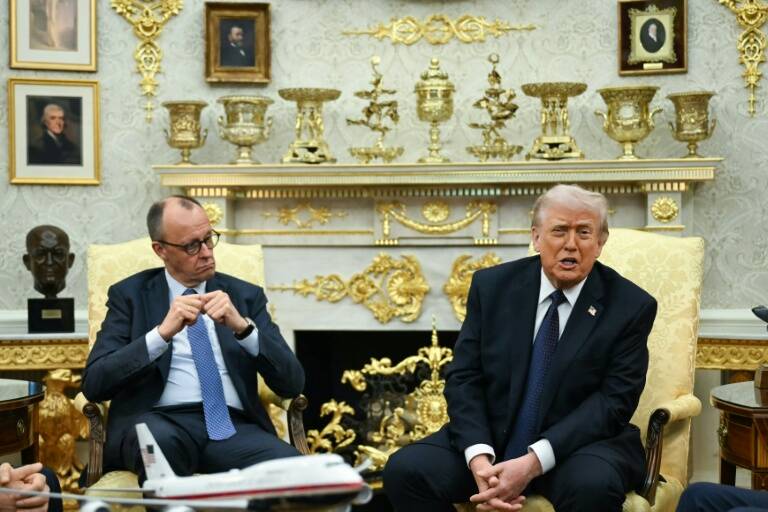
By Tuesday, Trump was in the Oval Office with German Chancellor Friedrich Merz — whose government has essentially decided to go along with all of this, with Merz telling reporters “this is not the time to lecture our partners and allies” — and the press pool finally got their first real crack at sustained questions. What followed was a master class in saying a great deal while explaining absolutely nothing.
Asked why there was no evacuation plan for the thousands of Americans stranded across a Middle East that is rapidly becoming a war zone, Trump shrugged it off: “Well, because it happened all very quickly.” This, from an administration that by its own Secretary of State’s admission knew weeks in advance that Israel was planning to strike. The State Department is now urging Americans in 14 countries to leave immediately — while much of the region’s airspace is closed and the government is offering no evacuation flights. Fly commercial, apparently, if you can find a flight. Asked what he’d do if post-regime Iran turned out to be just as dangerous as the current one, Trump allowed: “I guess the worst case would be — we do this, and then somebody takes over who’s as bad as the previous person… That could happen.”
Refreshing honesty, perhaps, for a war being sold as a clean and decisive military operation with clear objectives and no risk of the nation-building quagmires that defined Iraq and Afghanistan. Asked about Iran striking neutral Gulf states that had coexisted peacefully with their neighbor for decades, Trump said he was genuinely “surprised” — “Amazingly, they’re hitting countries that were, you know, let’s call them neutral. They lived together for a long time. I think they were surprised. I was surprised.” The man who launched a war, surprised that war spreads.
And then, just when you thought the justification carousel had run out of horses, Trump climbed back on for one more spin. Never mind Rubio’s “we knew Israel was going to do it” explanation from the day before. Never mind the Pentagon briefers who reportedly told Congress there was no intelligence indicating Iran was planning a first strike on American forces. On Tuesday, Trump offered a brand new version: “We were having negotiations with these lunatics, and it was my opinion that they were going to attack first. They were going to attack. If we didn’t do it, they were going to attack first. I felt strongly about that. So if anything, I might have forced Israel’s hand.”
His opinion. He felt strongly about it. That is the justification — the personal gut feeling of a man who cannot remember from one day to the next what timeline he gave for the war. Not intelligence. Not evidence. Not a legal framework or a congressional authorization or even a consistent story. A feeling. And for full measure, Trump also claimed the U.S. was “very nearly under threat” from Iran — a claim that bumps directly into his own Defense Intelligence Agency’s assessment that Iran could potentially develop a missile capable of reaching American soil by 2035. Nine years from now. Very nearly.
There’s one more thread that runs through all of this, and it matters as much as any of the battlefield developments or the policy contradictions. Trump has not delivered a single prime-time Oval Office address. He has not held a formal press conference. He announced the start of a war from a golf resort at 2:30 in the morning via a social media post. When reporters have shouted questions in public settings, he has ignored them. When he has spoken to journalists, it has been in brief one-on-one phone calls — easily ended the moment questions get uncomfortable, impossible to follow up on from anyone else in the room. A former Obama communications director described it plainly: “By eschewing an address to the nation, Trump clearly has no plan or intention to explain to the American people why we went to war with Iran, what happens next, and what victory looks like. By offering a different spin to every reporter whose call he answers, he comes across as making it up as he goes, which is probably the case.”
Tuesday’s Oval Office session was as close to accountability as this administration has allowed. And it produced the now-familiar spectacle of a president lobbing contradictions like grenades, expressing astonishment at consequences his own decisions set in motion, blaming Obama and Biden on Truth Social between appearances, and declaring everything is going magnificently about a war he said four days ago hadn’t yet started hitting hard.
Six Americans are dead. Hundreds of civilians in Iran are dead. The region is on fire from Beirut to Dubai. Gas jumped eleven cents overnight. The administration cannot keep its story straight for 24 consecutive hours. And the president was surprised.
This is what it looks like when a war is launched on vibes, sold on shifting justifications, and managed by a man who treats the press pool as a nuisance and accountability as someone else’s failed policy. We’ve seen this movie before. We know exactly how it ends.
We said no more.
**Unfugginbelievable is an independent, reader-supported investigation into the things that make us want to flip a table — then flip it back over and document everything on it. Every claim is fact-checked. Every source is real. No ads, no sponsors, no corporate overlords telling us what to leave out. If this work matters to you and you want to keep us caffeinated while we do it, buy us a cuppa at buymeacoffee.com/unfugginbelievable. We’ll drink it while reading the next filing.
Add comment
Comments