

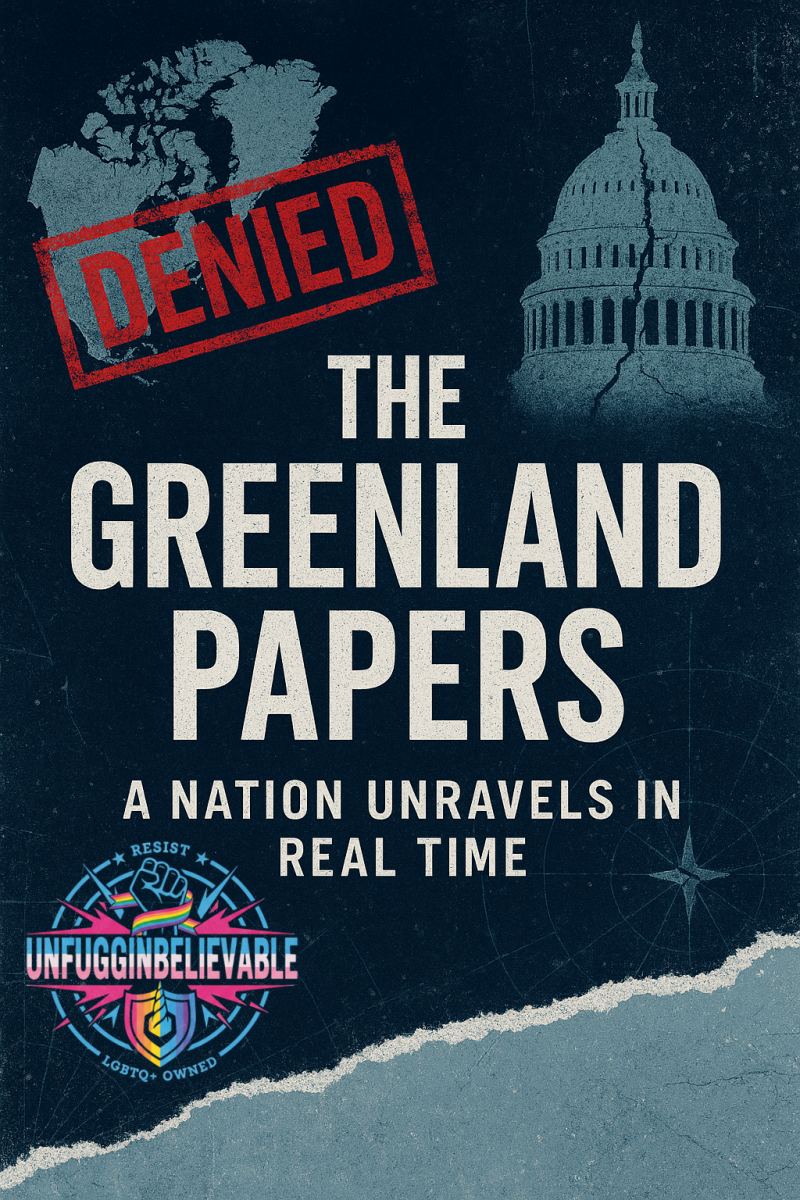
There are political crises, and then there are the kind of slow‑motion national breakdowns that future historians will study with the same horrified fascination normally reserved for train wrecks and cult documentaries. The Greenland Papers is the definitive record of one such moment — a twelve‑part descent into the chaos unleashed when a president tried to buy a sovereign nation, threw a tantrum when told no, and then proceeded to destabilize alliances, economies, institutions, and the American psyche itself.
This series follows the fallout step by step: the diplomatic humiliation, the global backlash, the economic gut‑punch, the authoritarian flirtations, the political fractures, the media distortion, the public awakening, and the final reckoning. It’s a chronicle of a republic pushed to its limits by a leader who treats the world like a yard sale and the presidency like a personal grievance machine.
If you’ve ever wondered how a modern democracy cracks — not in one dramatic explosion, but in a series of absurd, infuriating, surreal episodes — this is the map.
If you’ve ever felt like the country is living inside a fever dream — this is the diagnosis.
And if you’ve ever needed proof that satire is dead because reality murdered it — this is the exhibit.
Welcome to The Greenland Papers.
A saga of tantrums, tariffs, and a nation teetering on the edge.
THE GREENLAND TANTRUM — TRUMP TAXES AMERICA BECAUSE EUROPE WON’T GIVE HIM A TOY
Some days in American politics feel like déjà vu with a migraine, and then there are days like this one, when the President of the United States decides to punish half of Europe because they wouldn’t hand him Greenland like a party favor. In a move that would embarrass even the pettiest HOA president, Donald Trump slapped 10% tariffs on eight NATO allies—Denmark, Finland, France, Germany, the Netherlands, Norway, Sweden, and the United Kingdom—because they refused to indulge his Arctic real‑estate fantasies. These aren’t fringe economies. These are the countries that supply the United States with everything from pharmaceuticals to machinery to the cheese Americans pretend they don’t eat at 2 a.m. but absolutely do.
The fallout is immediate and brutal. Denmark’s medical equipment, Finland’s telecom components, France’s aircraft parts and wine, Germany’s cars and industrial machinery, the Netherlands’ electronics and refined petroleum, Norway’s seafood and aluminum, Sweden’s vehicles and pharmaceuticals, and the U.K.’s aerospace components and spirits—all of it now comes with a Trump‑imposed surcharge. And when Trump says he’s “punishing Europe,” what he actually means is that he’s punishing the American consumer who buys these goods, the American worker who relies on them, and the American economy that depends on them.
Tariffs are taxes. That’s it. That’s the whole story. A tariff is a tax on imports, paid not by Denmark or Sweden or “the globalists,” but by American companies the moment those goods hit U.S. soil. When a U.S. importer buys $100 worth of German auto parts and Trump slaps a 10% tariff on it, the importer now pays $110. And that importer has two choices: eat the cost and lose profit, or pass it along to the consumer and keep profit. Guess which one they pick. So car repairs get more expensive. Appliances get more expensive. Medications get more expensive. Beer gets more expensive. And when the tariff jumps to 25% in June, as Trump threatened, the price hikes will be even worse. This isn’t 4D chess. This is a toddler flipping the Monopoly board because he didn’t get to be the banker.
But the tantrum didn’t stop at tariffs. Trump also sent a sniveling, grievance‑soaked letter to Norway—shared with other NATO allies, including Sweden—because he didn’t win the Nobel Peace Prize. According to reporting from CBS, NBC, Yahoo News, and others, Trump wrote that because Norway “decided not to give me the Nobel Peace Prize for having stopped 8 Wars PLUS,” he “no longer feels an obligation to think purely of Peace.” He then linked this meltdown directly to Greenland, insisting he could now focus on “what is good and proper for the United States of America,” which in his mind apparently means annexing a sovereign territory. News outlets published short excerpts, including: “Considering your Country decided not to give me the Nobel Peace Prize for having stopped 8 Wars PLUS, I no longer feel an obligation to think purely of Peace…” and “…can now think about what is good and proper for the United States of America.” The rest of the letter—copyrighted, so I can’t reproduce it—includes claims that Denmark cannot defend Greenland, assertions that only Trump can protect the Arctic from Russia and China, a threat that he may no longer prioritize peace, and a demand for “Complete and Total Control” of Greenland. The tone reads like: “Dear Norway, you didn’t give me a trophy, so now I’m going to start a war.”
This is not normal. This is not sane. This is not leadership. This is a man who thinks foreign policy is a Yelp review and NATO is a customer‑service hotline. The President of the United States didn’t get a prize, threw a tantrum, threatened NATO, punished American consumers, tried to extort Europe, and tied all of it to his desire to buy Greenland like it was a timeshare. And MAGA will still insist this is “tough negotiating.” No. This is a man smashing the world’s fine china because the waiter didn’t clap when he walked in. And the bill? It’s coming to your mailbox.
THE WORLD RESPONDS: EUROPE ROLLS ITS EYES, RALLIES ITS FORCES, AND MOVES ON WITHOUT US
There’s a particular kind of silence that falls over the international community when the President of the United States behaves like a man trying to negotiate a hostage release with a snowman. It’s not fear. It’s not confusion. It’s the stunned, exhausted pause of allies who have finally realized that the world’s supposed superpower is being steered by someone who thinks Greenland is a clearance item he can haggle for. Trump expected Europe to fold. He expected NATO to grovel. He expected Greenland to be wrapped in a bow like a real‑estate closing gift. Instead, the world responded with a unified, resounding refusal that echoed from Copenhagen to Helsinki: absolutely not.
Denmark and Norway didn’t just repeat their earlier message that Greenland is not for sale—they reinforced it with action. Both countries increased their military presence in the Arctic, deploying additional patrol aircraft, expanding naval operations, and coordinating joint exercises with other Nordic nations. Not because they fear Trump will invade, but because they no longer trust him not to do something reckless. It’s the kind of precaution you take when the neighbor who once asked to borrow your ladder is now demanding the deed to your house. Trump’s behavior didn’t intimidate them; it reminded them that the United States, under his leadership, is no longer predictable enough to be taken at its word.
NATO, meanwhile, found itself in the bizarre position of having to reaffirm its own existence while tiptoeing around the tantrum of its largest member. Instead of focusing on Russia—the alliance’s actual threat—leaders were forced to hold emergency meetings, issue public statements of unity, and quietly prepare for the possibility that the United States might not show up if Article 5 were invoked. France and Germany accelerated joint defense planning. The United Kingdom reaffirmed its commitments. Finland and Sweden, now full NATO members, coordinated Arctic defense strategies with a seriousness that suggested they were preparing for a future where the U.S. is no longer the anchor but the liability.
And while Trump was busy punishing allies with tariffs, Europe began exploring trade frameworks that bypass the United States entirely. The EU opened new talks with Canada, Japan, and Australia. Nordic countries expanded energy and tech agreements with each other. France and Germany pushed for a “post‑American” trade strategy. This is what happens when the U.S. president behaves like a man who thinks diplomacy is a slot machine and the Arctic is the jackpot: other countries stop putting quarters in.
Even the Arctic Council, normally a calm forum for scientific cooperation, found itself dragged into the chaos. What used to be a venue for climate research and environmental policy suddenly became a geopolitical triage unit, forced to navigate U.S. instability, Russian opportunism, and Chinese expansion—all while Trump was busy demanding Greenland like a toddler demanding a pony.
Back home, American political leaders responded with their usual split‑screen predictability. Democrats condemned the tariffs, the threats, the letter, the Greenland obsession, and the general spectacle of a president acting like a rejected contestant on Shark Tank. Republicans, on the other hand, dusted off their well‑worn script: “I haven’t seen the letter.” “I don’t comment on hypotheticals.” “The president is just joking.” “The president is being taken out of context.” “The president is negotiating from strength.” It’s the same cycle every time: Trump says something authoritarian, Republicans pretend it didn’t happen, Trump says it again, Republicans say he was joking, Trump does it, Republicans shrug. It’s political enabling at its most cowardly, except the stakes aren’t a bad tweet—they’re global stability.
And then there’s the historical parallel that no one wants to say out loud but everyone can feel humming beneath the surface. I’m not saying Trump is Hitler, Putin, Mussolini, or any other strongman. I’m saying he behaves like a man who has read their biographies and underlined the wrong parts. The patterns are familiar: threatening neighbors, punishing allies, demanding territory, claiming victimhood when denied power, using economic pain as leverage, insisting only he can save the nation, framing dissent as treason. History doesn’t repeat, but it does audition new cast members. And Trump? He’s out here reading for the role of “Authoritarian Who Wanted Greenland.”
The world’s response to Trump’s threats wasn’t fear—it was recalibration. Europe is adjusting to a future where the United States is no longer the steady hand but the unpredictable variable. NATO is preparing for the possibility that the U.S. might not honor its commitments. Trade partners are building new alliances that don’t include us. And adversaries like Russia and China are watching the chaos with the kind of delighted patience usually reserved for predators who know their prey is limping.
Trump wanted Greenland. What he got instead was a global reminder that the United States, under his leadership, is no longer the adult in the room. And while he rages about Nobel Prizes and imaginary real‑estate deals, the rest of the world is quietly moving on.
THE AMERICAN WORKER GETS THE BILL FOR A PRESIDENT’S MELTDOWN
There’s a particular cruelty in watching a president wage economic war on his own citizens while insisting he’s doing it for their benefit. Trump’s Greenland tantrum, already a diplomatic embarrassment and a geopolitical gift to our adversaries, has now landed squarely on the backs of American workers who had no say in any of it. While he rages about Nobel Prizes and imaginary real‑estate deals, the people paying the price are the factory workers in Ohio, the truck drivers in Pennsylvania, the nurses in Michigan, the machinists in Wisconsin, the farmers in Iowa, and the small‑business owners in every ZIP code who now find themselves footing the bill for a tantrum they didn’t throw.
The economic fallout is not theoretical. It’s not abstract. It’s not something economists debate on cable news while sipping coffee in air‑conditioned studios. It’s real, immediate, and devastating. Tariffs are taxes, and taxes raise prices, and raised prices crush workers. That’s the entire equation. When Trump slapped tariffs on eight NATO allies, he didn’t punish Europe. He punished every American who buys anything made with steel, aluminum, machinery, pharmaceuticals, auto parts, electronics, medical devices, furniture, appliances, cars, tools, wine, beer, cheese, cosmetics, or half the items in their home. Denmark’s medical equipment, Sweden’s pharmaceuticals, Germany’s auto parts, the U.K.’s aerospace components — all of it now costs more because the president wanted to punish countries that refused to sell him Greenland like it was a souvenir at an airport kiosk.
Manufacturing workers are among the first to feel the blow. American factories rely heavily on European components, especially from Germany, Sweden, and the U.K. When those imports get taxed, factories face higher material costs, delayed shipments, canceled orders, reduced production, and eventually layoffs. We’ve seen this movie before. In 2018, Trump’s steel tariffs caused U.S. manufacturers to lose billions, Harley‑Davidson to move production overseas, auto plants to cut shifts, and tool‑and‑die shops to shut down. Now he’s running the same playbook again, except this time the justification isn’t even a flimsy claim about national security — it’s a personal vendetta over a piece of land he couldn’t buy.
Farmers, as always, are the collateral damage hall of fame. When Trump starts trade wars, other countries retaliate, and they don’t retaliate by taxing yachts or golf clubs. They retaliate by taxing soybeans, corn, pork, beef, dairy, and wheat — the very products American farmers depend on. We watched this happen when China retaliated in 2018, causing U.S. farm exports to collapse and bankruptcies to spike. Trump then bailed farmers out with taxpayer money and bragged about it like he’d written the checks himself. Now imagine Europe retaliating too. Farmers aren’t just collateral damage. They’re the punching bag in Trump’s geopolitical gym.
Small businesses, the backbone of the American economy, are next in line. They don’t have lobbyists or offshore accounts or billion‑dollar cushions. They have tight margins, local customers, real bills, real employees, and real consequences. When tariffs hit, small businesses can’t absorb the cost. They raise prices or they die. And Trump’s Greenland tantrum just handed them a fresh stack of invoices they can’t afford.
Retail workers feel the shockwaves too. Retail relies heavily on European goods — clothing, furniture, appliances, electronics, cosmetics, tools, toys. When prices rise, customers buy less. When customers buy less, stores cut hours. When stores cut hours, workers lose income. When stores lose revenue, they close. This isn’t complicated economics. This is gravity.
Even healthcare workers aren’t spared. A shocking amount of U.S. medical equipment and pharmaceuticals come from Denmark, Sweden, Germany, and the U.K. Tariffs mean higher hospital costs, higher insurance premiums, higher patient bills, delayed equipment upgrades, budget cuts, and staffing cuts. Imagine explaining to a nurse that her hospital can’t afford new ventilators because the president wanted to buy Greenland like it was a foreclosure property.
And then there’s the gig economy — Uber drivers, DoorDashers, Instacart workers — people already living on razor‑thin margins who rely on affordable gas, affordable car repairs, affordable tires, and affordable parts. Tariffs raise all of those. So the people who can least afford it get squeezed the hardest.
The historical parallels are impossible to ignore. I’m not saying Trump is Mussolini, Putin, or Hitler. I’m saying he acts like a man who admires the way they handled “disloyal” economies. Strongmen always punish enemies, reward loyalists, use economic pain as leverage, blame foreigners for domestic problems, demand territory, claim victimhood, and insist only they can fix it. Trump’s Greenland tantrum checks every box except “invade Poland,” and frankly, I’m not convinced he wouldn’t try if someone told him Poland had oil, gold, or a golf course.
The unbelievable part is that Trump’s tantrum over Greenland isn’t just embarrassing or reckless or historically illiterate. It’s economically catastrophic for the very Americans he claims to champion. He didn’t punish Europe. He punished the worker, the farmer, the nurse, the trucker, the teacher, the retiree, the single parent, and the small‑business owner — all because he didn’t get a Nobel Prize and Denmark wouldn’t sell him a giant ice cube. This isn’t leadership. This is a man‑child with a tariff gun, firing wildly into a crowd of his own supporters.
THE ARCTIC POWER VACUUM: HOW TRUMP’S TANTRUM OPENED THE DOOR FOR RUSSIA AND CHINA
There’s a strange, sinking feeling that comes when you realize the world’s most powerful nation has effectively left its front door wide open while its president screams at the neighbors about a property they don’t want to sell. Trump’s Greenland meltdown didn’t just embarrass the United States or strain alliances; it created a geopolitical vacuum so large that Russia and China practically waltzed into the Arctic with a welcome mat. While Trump was busy threatening NATO, insulting allies, and demanding Greenland like a spoiled heir demanding a trust‑fund payout, two countries with actual long‑term strategies—Russia and China—quietly moved their pieces across the Arctic chessboard with the precision of grandmasters who just watched their opponent flip his own king over and storm out of the room.
Russia, which has been eyeing the Arctic like a dragon guarding a treasure hoard, didn’t waste a second. The region is a jackpot of oil, gas, rare earth minerals, shipping lanes, and military positioning, and Moscow has been preparing for this moment for decades. They expanded military bases along the Northern Sea Route, deployed more icebreakers than the rest of the world combined, increased submarine patrols, and claimed vast swaths of the Arctic seabed. They even conducted joint exercises with China, a partnership that should have set off every alarm bell in Washington. Instead, Trump was too busy yelling at Denmark for refusing to sell him a frozen rock. It’s the geopolitical equivalent of arguing with a barista while someone steals your car.
China, for its part, has never let something as trivial as geography get in the way of ambition. They call themselves a “near‑Arctic state,” which is like calling yourself a “near‑homeowner” because you once walked past a Zillow listing. But thanks to Trump’s chaos, China now has new trade openings, new diplomatic leverage, new Arctic partnerships, and new investment opportunities. They’ve invested in Greenland’s mining sector, pushed for Arctic shipping routes, expanded their icebreaker fleet, and built scientific stations that double as surveillance posts. While Trump punished NATO with tariffs, China quietly built the infrastructure to dominate the Arctic economy for the next century. This is what happens when the U.S. president thinks foreign policy is a reality show and the Arctic is the prize behind Door Number Three.
NATO, meanwhile, found itself in the absurd position of having to babysit the United States while trying to counter Russia. Instead of focusing on Moscow’s aggression, alliance leaders were forced to reaffirm Article 5 without the U.S., increase Arctic surveillance, and coordinate defense strategies that assumed Washington might not show up. France and Germany accelerated joint planning. Finland and Sweden, now full NATO members, took Arctic defense into their own hands. The United Kingdom publicly reaffirmed its commitments. The message was clear: if the United States wants to act like an unreliable uncle who shows up drunk to Thanksgiving and threatens to sell the house, the rest of the family will quietly make other plans.
Even the Arctic Council, normally a calm forum for scientific cooperation, was dragged into the chaos. What used to be a venue for climate research and environmental policy suddenly became a crisis‑management hub, forced to navigate U.S. instability, Russian opportunism, and Chinese expansion. Trump’s Greenland obsession turned a scientific body into a geopolitical emergency room.
The U.S. military has been warning for years that the Arctic is a strategic hotspot, that Russia is militarizing it, that China is investing heavily, and that the United States is falling behind. Instead of strengthening alliances, Trump weakened them. Instead of coordinating defense, he threatened it. Instead of building Arctic capacity, he tried to buy Greenland like it was a foreclosure property. The Pentagon doesn’t need Greenland. It needs allies. And Trump just slapped tariffs on eight of them.
The power vacuum he created is a gift to authoritarians everywhere. When the United States steps back, someone steps in. And right now, that someone is Russia, China, and every strongman who sees opportunity in chaos. Trump’s behavior mirrors the exact patterns used by authoritarian leaders throughout history: undermine alliances, create instability, demand territory, punish dissent, claim victimhood, use economic pain as leverage, insist only you can fix it. I’m not saying he’s Hitler or Putin or Mussolini. I’m saying he’s auditioning—loudly, sloppily, and with terrible lighting. And while he auditions, the real authoritarians are taking the stage.
Trump didn’t just embarrass the United States. He didn’t just punish American workers. He didn’t just destabilize NATO. He opened the door for Russia to expand militarily, for China to expand economically, for Europe to move on without us, for the Arctic to become a battleground, and for the U.S. to lose influence for a generation. All because he wanted Greenland. All because he didn’t get a Nobel Prize. All because he thinks foreign policy is a real‑estate negotiation. This isn’t strategy. This is geopolitical malpractice. And the world is already paying the price.
THE INSURRECTION ACT WHISPER: HOW TRUMP USES CRISIS TO JUSTIFY CRACKDOWNS
There’s a moment in every unraveling democracy when the leader who created the chaos begins insisting he’s the only one who can restore order. It’s a pattern as old as authoritarianism itself, and watching Trump inch toward that familiar script is like watching a slow‑motion replay of history’s worst instincts. His Greenland tantrum, his NATO threats, his economic self‑sabotage, his diplomatic meltdowns — all of it has created the perfect storm for him to claim that America is in crisis, and that only he has the strength to fix it. And right on cue, he’s begun floating the idea of invoking the Insurrection Act, as if the country needs martial law because Denmark hurt his feelings.
The most disturbing part isn’t that he’s saying it. It’s that he’s saying it with the casual entitlement of a man who believes the presidency is a personal fiefdom. Trump has always treated power like a toy he’s entitled to break, but now he’s treating it like a weapon he’s entitled to use. The Insurrection Act — a law meant for genuine national emergencies — has become his rhetorical security blanket, something he drags out whenever he feels cornered, embarrassed, or denied. He used it as a threat during protests, during political disagreements, during moments when he wanted to project dominance. Now he’s using it as a backdrop to his Greenland meltdown, as if the refusal of a sovereign nation to sell him land is grounds for domestic military deployment.
This is how strongmen operate. They manufacture instability, then point to the instability as proof that they need more power. They create the crisis, then claim the crisis justifies extraordinary measures. They break the system, then insist the system is broken. Trump’s behavior mirrors the same patterns used by leaders who dismantled democracies from the inside: undermine institutions, delegitimize opponents, sow chaos, then demand emergency authority to “restore order.” It’s the political equivalent of lighting your own house on fire and then demanding the deed to the neighbor’s because you’re “the only one who knows how to handle flames.”
The Greenland fiasco is just the latest accelerant. Trump’s tariffs have destabilized markets. His threats have rattled allies. His tantrums have emboldened adversaries. His letter — the one dripping with self‑pity over the Nobel Prize he didn’t get — has made the United States look unhinged. And now, with the consequences of his own actions piling up, he’s positioning himself as the only person who can manage the fallout. It’s the same playbook used by every authoritarian who ever claimed that democracy was too messy, too slow, too weak to handle the crises they themselves created.
What makes this moment especially dangerous is the chorus of enablers who pretend not to hear what he’s saying. Republicans in Congress, who once would have recoiled at the idea of a president threatening to deploy the military against his own citizens, now shrug it off as “just Trump being Trump.” They minimize it, excuse it, normalize it. They treat authoritarian rhetoric like a personality quirk instead of a warning siren. And every time they do, the boundary moves a little further. The unacceptable becomes debatable. The debatable becomes plausible. The plausible becomes policy.
Meanwhile, the American public is left to navigate the consequences of a leader who governs by tantrum and threat. Workers are paying more for goods because of tariffs he imposed out of spite. Farmers are losing markets because of trade wars he started out of ego. Allies are distancing themselves because of insults he hurled out of insecurity. And now, as the chaos he created begins to circle back, he’s hinting that the solution might be military force — not against foreign adversaries, but against Americans.
This is the part of the story where democracies either wake up or fall asleep at the wheel. Trump’s flirtation with the Insurrection Act isn’t about law and order. It’s about power and fear. It’s about creating enough turmoil that he can claim extraordinary authority. It’s about turning his own failures into justification for his own expansion of control. It’s about using the language of crisis to mask the reality that he is the crisis.
And the most unbelievable part is that it all began with a tantrum over Greenland. A tantrum that spiraled into tariffs, threats, diplomatic breakdowns, global instability, and now whispers of domestic military deployment. A tantrum that has become a pretext for something far more dangerous than a failed real‑estate fantasy. A tantrum that reveals, yet again, that Trump doesn’t want to lead a democracy — he wants to command a kingdom.
The question now isn’t whether he’ll keep pushing. It’s how far he thinks he can go before someone stops him.
THE REPUBLIC SPLITS: HOW TRUMP’S GREENLAND CRISIS HAS IGNITED A POLITICAL CIVIL WAR AT HOME
There’s a moment in every national crisis when the political fault lines stop being theoretical and start cracking open in real time, and Trump’s Greenland spiral has become that moment for the United States. What began as a diplomatic embarrassment and escalated into a geopolitical disaster has now detonated inside our own borders, splitting the country into factions that no longer pretend to be on the same team. The Greenland tantrum didn’t just destabilize NATO or empower Russia and China. It destabilized us. It exposed the fractures in our political system, widened them, and poured gasoline into them, leaving a nation that feels less like a unified republic and more like a collection of rival camps staring each other down across a widening chasm.
The Republican Party, once a coalition of business conservatives, national‑security hawks, libertarians, and social traditionalists, now looks like a house with half its rooms condemned. The MAGA faction has doubled down on Trump’s Greenland obsession, insisting that the tariffs, the threats, the letter, and the diplomatic carnage are all signs of “strength.” They’ve embraced the narrative that Europe is weak, NATO is obsolete, and Trump alone sees the “real game” unfolding in the Arctic. Meanwhile, traditional conservatives—those who still remember what foreign policy is supposed to look like—are recoiling from the instability. National‑security Republicans, the ones who spent decades warning about Russia, are quietly panicking as Trump hands Moscow strategic victories like party favors. The donor class is pulling back, worried that the chaos is bad for markets. Governors and state leaders are breaking ranks, trying to distance themselves from a president who seems determined to turn the United States into a geopolitical punchline. It’s the closest the GOP has come to an ideological civil war since the Tea Party era, except this time the stakes aren’t tax rates—they’re national stability.
Democrats, for their part, are unified but alarmed. They’re not just criticizing Trump; they’re preparing for the possibility that the United States is entering a constitutional danger zone. Hearings are being drafted. Oversight demands are piling up. National‑security warnings are being issued with a seriousness that suggests this isn’t just politics anymore—it’s triage. Economic emergency proposals are circulating as workers, farmers, and small businesses feel the immediate pain of Trump’s tariffs. There’s a growing sense among Democrats that Trump’s instability is no longer a partisan issue but a national threat, the kind that requires institutions to brace themselves for impact.
Inside the intelligence community and the military, the unease is palpable. Not conspiratorial, not dramatic—just the quiet, professional dread of people who understand how fragile global stability really is. Pentagon officials have been warning for years that the Arctic is a strategic hotspot, that Russia is militarizing it, that China is investing heavily, and that the United States is falling behind. Now they’re watching a president undermine alliances, alienate partners, and destabilize the very structures that keep the Arctic from becoming a battleground. Intelligence officials are warning about Russia and China exploiting the chaos. Quiet conversations about continuity of government—normally reserved for natural disasters or foreign attacks—are happening with a frequency that should unsettle anyone paying attention. The sense that the president’s impulses are now a liability is no longer whispered; it’s understood.
And then there’s the public, caught in the crossfire of a political system tearing itself apart. Workers are furious about rising prices. Farmers are livid about retaliatory tariffs. Veterans are horrified by threats to NATO. Suburban voters are exhausted by the drama. Young voters are radicalized by the instability. MAGA supporters, meanwhile, are doubling down, treating Trump’s Greenland fixation as proof that he’s the only one willing to “stand up to the world,” even as the world laughs, recoils, or quietly moves on. The national mood is a volatile mix of fear, fatigue, and fury, the kind that doesn’t dissipate on its own.
The historical parallels are impossible to ignore. I’m not saying Trump is any particular figure from the past, but the patterns are familiar to anyone who has ever cracked open a history book. The late Weimar Republic, where political factions hardened into irreconcilable enemies. The final years of the Roman Republic, where institutional decay met personal ambition. The collapse of the French Fourth Republic, where instability became the justification for extraordinary measures. Democracies rarely fall in a single dramatic moment. They erode, fracture, and weaken until one crisis pushes them past the point of recovery. Trump’s Greenland meltdown isn’t that final crisis, but it’s the kind of event that reveals how close the fault lines already are.
The most unsettling part is that none of this was inevitable. It wasn’t caused by a natural disaster or a foreign attack. It wasn’t the result of some unavoidable geopolitical shift. It was caused by a president who threw a tantrum because Denmark wouldn’t sell him Greenland, and then used that tantrum to justify tariffs, threats, diplomatic breakdowns, and authoritarian flirtations. It was caused by a political system too divided to stop him, too polarized to respond coherently, and too exhausted to recognize the danger until it was already unfolding.
The republic hasn’t collapsed. But it has cracked. And the cracks are widening. The question now isn’t whether Trump will keep pushing. It’s how far he thinks he can go before the system breaks—or before someone finally decides to stop him.
THE MEDIA MAELSTROM: HOW TRUMP’S GREENLAND FANTASY TURNED THE INFORMATION WAR INSIDE OUT
There’s a point in every political meltdown when the media stops reporting the story and becomes part of it, and Trump’s Greenland spiral has dragged the American press into the chaos like a riptide. What began as a bizarre diplomatic tantrum has now metastasized into a full‑blown information war, with every outlet, pundit, commentator, and conspiracy peddler scrambling to frame the narrative before the truth can even catch its breath. The Greenland fiasco didn’t just destabilize alliances or fracture the political system. It detonated the media landscape, turning every screen in America into a battleground where facts, fantasies, and outright fabrications collide at full speed.
The mainstream press, exhausted from years of whiplash, tried at first to treat the Greenland story like any other diplomatic misstep. They reported the tariffs, the letter, the NATO fallout, the global backlash. They interviewed experts who spoke in the careful, measured tones of people who still believe the world operates on rational principles. But as the story spiraled into absurdity — as Trump insisted he was being “disrespected,” as he claimed he was owed a Nobel Prize, as he threatened allies, as he floated the Insurrection Act — the press found itself struggling to cover a presidency that behaves less like a government and more like a fever dream. The traditional tools of journalism — context, analysis, fact‑checking — suddenly felt like umbrellas in a hurricane.
Meanwhile, right‑wing media did what it always does when Trump veers into the surreal: it built a parallel universe where the Greenland tantrum was not a tantrum at all but a masterstroke of geopolitical genius. In this alternate reality, Trump wasn’t embarrassing the nation; he was “thinking big.” He wasn’t alienating allies; he was “asserting dominance.” He wasn’t destabilizing NATO; he was “rebalancing global power.” The tariffs weren’t punitive; they were “strategic leverage.” The letter wasn’t unhinged; it was “bold diplomacy.” And the refusal to sell Greenland wasn’t a rejection; it was “proof that Trump scares the global elites.” It’s a media ecosystem where the laws of physics don’t apply, where up is down, where chaos is strength, and where the president’s most erratic impulses are repackaged as visionary leadership.
Social media, of course, took the whole thing and turned it into a carnival. Memes of Trump planting a flag in Greenland spread like wildfire. Conspiracy theorists insisted Denmark was hiding secret mineral deposits. Influencers posted videos explaining why Greenland was “the key to the future of humanity.” Bots amplified every lie, every rumor, every half‑truth. And ordinary Americans, already overwhelmed by rising prices, political division, and global instability, found themselves drowning in a sea of noise where it became nearly impossible to tell what was real and what was manufactured. The Greenland crisis didn’t just break the news cycle. It broke the public’s ability to process the news cycle.
The most dangerous part of this media maelstrom is how effectively it mirrors the tactics of authoritarian regimes throughout history. Strongmen don’t just attack the press; they overwhelm it. They flood the zone with so much chaos, so many contradictions, so many narratives, that the truth becomes just one more voice in the din. Trump doesn’t need to silence the media. He just needs to make it impossible for the media to be heard. And in the confusion, he positions himself as the only reliable narrator, the only source of “real” information, the only voice his supporters trust. It’s a strategy as old as propaganda itself: disorient the public, then claim to be the compass.
The result is a nation where half the population is watching one movie and the other half is watching a completely different one, and neither side can agree on the plot, the characters, or the ending. The Greenland meltdown has become a Rorschach test for the American psyche. To some, it’s proof of Trump’s instability. To others, it’s proof of his brilliance. To many, it’s just another exhausting chapter in a saga that feels like it has no bottom. And through it all, the media — fractured, polarized, overwhelmed — is left trying to report on a reality that no longer behaves like reality.
The unbelievable part is that this entire information war was sparked by a tantrum over a piece of land Trump couldn’t buy. A tantrum that spiraled into tariffs, threats, global instability, domestic fractures, authoritarian flirtations, and now a media landscape so distorted that the truth has to fight for oxygen. A tantrum that has turned every screen in America into a battlefield. A tantrum that reveals, yet again, that the greatest danger to the republic isn’t the chaos Trump creates — it’s the way that chaos rewrites the very language we use to understand the world.
The question now isn’t whether the media can keep up. It’s whether the country can survive a reality where the truth has become optional.
THE NATIONAL PSYCHE CRACKS: LIVING IN THE SHADOW OF A PRESIDENT’S CHAOS
There comes a point in a country’s unraveling when the crisis stops being about policies or alliances or even the president himself, and instead becomes something quieter and far more dangerous: the moment when the people begin to change. Trump’s Greenland meltdown, already a diplomatic disaster and a political earthquake, has now seeped into the national psyche like a slow‑moving toxin. It’s no longer just a story about tariffs or NATO or Arctic ambitions. It’s a story about what happens to a democracy when chaos becomes the background noise of daily life, when instability becomes routine, when absurdity becomes normal, and when the public begins to adapt to a reality that would have once seemed unthinkable.
You can feel it everywhere — in the way people talk, in the way they scroll, in the way they brace themselves before opening the news. There’s a heaviness in the air, a kind of national fatigue that settles into the bones. Workers who once argued passionately about politics now shrug with a hollow laugh, as if the whole system is a cosmic joke they’re too tired to understand. Parents who used to shield their kids from the ugliness of the world now find themselves explaining why the president is threatening allies over a piece of land he can’t have. Young people, raised on a steady diet of crisis, look at the chaos not with shock but with a weary sense of inevitability. The country hasn’t just been destabilized. It’s been emotionally rewired.
The Greenland tantrum didn’t create this shift, but it accelerated it. It pushed the absurdity past the point where satire can keep up. It forced Americans to confront the reality that the person leading the nation is capable of decisions so erratic, so petty, so wildly disconnected from the responsibilities of the office that the public has begun to lose its sense of what leadership even looks like. When a president threatens NATO because he didn’t get a Nobel Prize, when he punishes American workers because Denmark wouldn’t sell him land, when he floats the Insurrection Act because he feels disrespected, the country doesn’t just lose stability. It loses its emotional center of gravity.
And in that vacuum, something corrosive begins to grow. Cynicism becomes a coping mechanism. Outrage becomes a reflex. Numbness becomes a shield. People stop expecting competence. They stop expecting honesty. They stop expecting sanity. They begin to assume that every day will bring a new crisis, a new embarrassment, a new threat, a new humiliation. They begin to live in a state of low‑grade dread, the kind that hums beneath the surface even on quiet days. It’s the psychological toll of a nation that no longer trusts its own government to behave like an adult.
The cultural shift is unmistakable. Late‑night comedians, once the pressure valve of American politics, now sound less amused and more exhausted. Artists and writers, who once found inspiration in political absurdity, now describe feeling overwhelmed by the sheer volume of it. Teachers report students asking whether the United States is still respected in the world. Therapists talk about clients who feel powerless, anxious, or detached. Even the language people use has changed — everything is “unprecedented,” “chaotic,” “unstable,” “surreal.” The country speaks in crisis terms because the country lives in crisis terms.
And beneath all of this is the quiet, unspoken fear that the chaos is not temporary. That this is not a phase. That this is what America is becoming. The Greenland meltdown feels like a metaphor for something larger — a nation trying to buy a fantasy version of itself while the real one crumbles under the weight of its own contradictions. A country that once prided itself on stability now feels like a place where anything can happen and none of it will be good. A democracy that once believed in its own resilience now feels fragile, brittle, and uncertain.
The most unsettling part is how quickly people adapt. Humans can get used to almost anything, even dysfunction. Especially dysfunction. And once chaos becomes normal, it becomes harder to reverse. The danger isn’t just that Trump behaves like a man who believes the country is his personal property. The danger is that the public begins to accept it. Begins to expect it. Begins to internalize it. Begins to reshape their worldview around it. That’s how democracies erode — not with a single dramatic collapse, but with a slow, steady shift in what people believe is possible, acceptable, or inevitable.
The Greenland crisis didn’t just fracture alliances or destabilize markets or ignite political civil war. It cracked something deeper — the country’s sense of itself. The question now isn’t whether the nation can survive Trump’s tantrums. It’s whether it can survive the emotional and cultural transformation those tantrums have triggered. A republic can rebuild institutions. It can repair alliances. It can recover economically. But once the national psyche breaks, once people stop believing in the stability of their own democracy, the path back becomes far more uncertain.
And that is the true cost of this moment — not the tariffs, not the threats, not the diplomatic fallout, but the quiet, creeping realization that the country is changing in ways that may not be reversible. The Greenland tantrum will eventually fade from the headlines. But the emotional scar it leaves behind may last far longer.
THE LEGAL RECKONING: WHEN A PRESIDENT’S FANTASY COLLIDES WITH THE RULE OF LAW
There’s a point in every political disaster when the lawyers finally enter the room, look around at the wreckage, and realize they’re not dealing with a crisis so much as a crime scene. Trump’s Greenland meltdown, already a diplomatic humiliation and a geopolitical catastrophe, has now crossed into the territory where attorneys, investigators, and constitutional scholars begin circling like emergency responders trying to assess the structural damage. What began as a tantrum over a piece of land he couldn’t buy has now triggered a legal reckoning that reaches into every corner of government, exposing the fragility of the rule of law when confronted with a president who treats it like a suggestion rather than a constraint.
The first cracks appeared when Trump imposed tariffs on eight NATO allies for no legitimate national‑security reason, a move so nakedly retaliatory that trade lawyers practically sprinted to their desks. The law allows tariffs for specific, defined purposes — not because the president is sulking over a diplomatic slight. The Greenland tantrum wasn’t just petty. It was potentially unlawful. And as American companies began absorbing the costs, lawsuits started forming like storm clouds. Importers challenged the tariffs as arbitrary and capricious. Industry groups argued that the president had exceeded his statutory authority. Constitutional scholars warned that Trump was using economic power in ways Congress never intended. The courts, already strained by years of Trump‑era litigation, braced for another wave.
Then came the letter — the one dripping with self‑pity over the Nobel Prize he didn’t get, the one threatening to abandon peace because Norway didn’t applaud loudly enough, the one tying national security to his personal grievances. Diplomats cringed. Historians winced. Lawyers took notes. A president can embarrass himself. He can embarrass the country. But when he begins linking foreign policy decisions to personal vendettas, he crosses into territory where congressional oversight committees start sharpening their pencils. The letter wasn’t just unhinged. It was evidence — evidence of motive, evidence of intent, evidence of a president using the powers of his office for reasons that have nothing to do with the national interest.
Congress, already rattled by the Greenland fiasco, began drafting subpoenas. Oversight committees demanded documents related to the tariffs, the letter, the internal deliberations, the national‑security assessments, the communications with NATO allies. Staffers whispered about whether the president had consulted anyone before threatening to destabilize the Arctic. Legal analysts debated whether the Greenland tantrum constituted an abuse of power. Even some Republicans, usually content to hide behind platitudes and evasions, began to worry that the president had finally crossed a line that couldn’t be blurred with spin.
Inside the executive branch, the legal panic was quieter but more intense. Government lawyers found themselves trying to justify decisions that had no legal foundation. National‑security attorneys scrambled to explain why the president was threatening allies over a real‑estate fantasy. Trade lawyers tried to reconcile the tariffs with statutes that clearly didn’t apply. White House counsel reportedly spent days trying to contain the fallout, drafting memos, preparing defenses, and attempting to create a paper trail that made the president’s actions look less like a tantrum and more like policy. It was the bureaucratic equivalent of trying to build a parachute after the plane has already left the runway.
The intelligence community, already uneasy, began documenting concerns. Analysts warned that Russia and China were exploiting the chaos. Legal advisors questioned whether the president’s actions were compromising national security. Internal reports circulated about the risks of destabilizing NATO. And as always happens in moments like this, someone leaked. The public learned just enough to understand that the people tasked with protecting the country were now also trying to protect it from its own president.
The most ominous part of the legal reckoning is how familiar it feels. Democracies don’t collapse because one man breaks the law. They collapse when the law becomes too weak to stop him. Trump’s Greenland meltdown has become a test of whether the rule of law still has the strength to restrain a president who believes he is entitled to act without restraint. The courts can issue rulings. Congress can issue subpoenas. Inspectors general can issue reports. But none of it matters if the president refuses to comply, if his allies refuse to enforce accountability, if the public becomes too numb to care.
And that is the quiet terror beneath this moment — not that Trump broke norms or bent laws or abused power, but that the system designed to stop him is now straining under the weight of his chaos. The Greenland tantrum will eventually fade from the headlines. The lawsuits will wind their way through the courts. The investigations will produce reports. But the damage — the precedent that a president can destabilize alliances, punish allies, threaten peace, and weaponize economic power for personal reasons — will linger long after the legal dust settles.
The question now isn’t whether Trump will face consequences. It’s whether the rule of law can survive a president who treats it as an obstacle rather than an obligation. And if it can’t, the Greenland crisis may be remembered not as a diplomatic embarrassment, but as the moment the legal foundations of the republic began to crack.
THE POST‑AMERICAN WORLD: HOW TRUMP’S GREENLAND CRISIS PUSHED ALLIES INTO A NEW ERA
There’s a moment in every great power’s decline when the rest of the world quietly begins making other plans, and Trump’s Greenland meltdown has become that moment for the United States. What began as a tantrum over a territory he couldn’t buy has now rippled outward into a global recalibration, a subtle but unmistakable shift in how nations think about America, rely on America, and prepare for a future where America may no longer be the steady hand at the center of the international order. The Greenland crisis didn’t just embarrass the United States. It accelerated a transformation that had been building for years — the emergence of a post‑American world.
You can see it in the way Europe responded, not with panic or deference, but with a kind of weary pragmatism. When Trump threatened NATO, insulted allies, and slapped tariffs on eight countries for refusing to indulge his Arctic fantasies, European leaders didn’t rush to appease him. They began planning around him. France and Germany accelerated their joint defense initiatives, not as a symbolic gesture but as a practical necessity. Finland and Sweden, now full NATO members, deepened their Arctic coordination with a seriousness that suggested they were preparing for a world where the United States might not show up. The United Kingdom, long America’s closest partner, reaffirmed its commitments to Europe with a tone that felt less like loyalty and more like resignation. The message was clear: if the United States wants to behave like an unreliable narrator, Europe will write its own script.
Beyond Europe, the shift is even more pronounced. Canada, Japan, Australia, and South Korea — countries that once built their foreign policy around American stability — have begun forging new trade agreements, new security partnerships, and new diplomatic frameworks that don’t depend on Washington. Not because they want to abandon the United States, but because they can no longer assume the United States will act in its own interests, let alone theirs. Trump’s Greenland tantrum, with its threats, its tariffs, its letter dripping with self‑pity, became the final confirmation that America’s unpredictability is no longer an anomaly. It’s a pattern.
And then there are the rivals — Russia and China — who have treated the Greenland crisis like a gift wrapped in red, white, and blue. While Trump was busy punishing allies and destabilizing NATO, Russia expanded its Arctic military presence, strengthened its energy partnerships, and positioned itself as the only major power with a coherent strategy for the region. China, ever opportunistic, deepened its investments in Greenland, expanded its icebreaker fleet, and pushed for new shipping routes through the Arctic. They didn’t have to outmaneuver the United States. They simply had to wait for Trump to do it for them.
The most striking part of this global shift is how quietly it’s happening. There are no dramatic declarations, no grand speeches about a new world order. Just a steady, deliberate reorientation — trade deals signed without American input, defense agreements negotiated without American leadership, diplomatic summits held without American presence. It’s the geopolitical equivalent of friends planning a trip without inviting the person who always starts fights at the restaurant. No one wants to say it out loud, but everyone knows why it’s happening.
Even institutions that once relied on American leadership have begun adjusting. The United Nations, long accustomed to U.S. dominance, now sees Europe, Canada, and Japan stepping into roles the United States used to fill. The World Trade Organization, battered by Trump’s tariffs and threats, has started looking to other nations for stability. The Arctic Council, once a model of cooperation, now operates under the assumption that the United States may be more of a disruptor than a partner. The international system hasn’t collapsed. It has simply begun to evolve without waiting for America to catch up.
What makes this moment so consequential is not that the United States is withdrawing from the world, but that the world is withdrawing from the United States. Not out of anger, but out of necessity. Not because they want to replace American leadership, but because they can no longer rely on it. Trump’s Greenland meltdown didn’t create this shift, but it crystallized it. It showed allies that the United States is no longer the predictable, rational actor it once was. It showed rivals that American chaos is an opportunity. It showed the world that the international order built after World War II is no longer anchored by a country capable of holding it together.
The most unbelievable part is how preventable it all was. A stable president, a coherent foreign policy, a functioning diplomatic corps — any of these could have slowed or reversed the global drift. Instead, the United States got a leader who treated alliances like personal grudges, diplomacy like a reality show, and global stability like a bargaining chip. The Greenland tantrum will eventually fade from memory, but the shift it accelerated will not. The world is already adjusting to a future where American leadership is optional.
The question now isn’t whether the United States can regain its place at the center of the global order. It’s whether the world will still be waiting if it ever tries.
THE PUBLIC AWAKENS: WHEN A NATION FINALLY SAYS “ENOUGH”
There’s a moment in every national unraveling when the public, after years of swallowing outrage like bitter medicine, finally reaches the point where the spoon snaps. Trump’s Greenland meltdown — the tantrum, the tariffs, the threats, the letter, the global humiliation — has now pushed Americans past that breaking point. What began as disbelief, then morphed into exhaustion, then hardened into numbness, has finally erupted into something louder, sharper, and far more dangerous for any leader who mistakes silence for consent. The country is waking up, and it is not waking up gently.
You can feel the shift in the streets before you see it on the news. The murmurs have turned into conversations, the conversations into arguments, the arguments into action. Workers who once shrugged off the rising prices as “just another Trump thing” are now furious that their paychecks are being eaten alive by tariffs imposed because the president couldn’t buy a frozen island. Farmers who once tolerated the trade wars as patriotic sacrifice are now staring at empty silos and retaliatory tariffs and realizing they’ve been used as cannon fodder in a geopolitical tantrum. Nurses, teachers, truckers, and small‑business owners — the people who keep the country functioning while Washington plays dress‑up — are no longer rolling their eyes. They’re rolling up their sleeves.
The protests began quietly, almost politely, as if the public wasn’t sure whether it was allowed to be angry about something as absurd as a president trying to purchase Greenland. But absurdity has a way of becoming fuel, and soon the crowds grew. Signs appeared that read like punchlines: “No, You Can’t Have Greenland,” “Stop Taxing My Groceries Because You’re Mad at Denmark,” “NATO Isn’t Your Ex‑Girlfriend.” The humor was sharp, but the anger underneath it was unmistakable. People weren’t just mocking Trump. They were mocking the idea that they should have to live in a country where the president’s emotional instability is a line item on their monthly budget.
And then the protests stopped being funny. They grew larger, louder, more focused. Veterans marched because they understood what it means to threaten NATO. Students marched because they were tired of inheriting a world on fire. Parents marched because they were tired of explaining to their children why the president behaves like a man who lost a custody battle with reality. Even some Republicans — the ones who still remember what governing is supposed to look like — began to break ranks, their silence finally cracking under the weight of the absurdity.
The public awakening wasn’t just in the streets. It was in the polls, the town halls, the letters to editors, the calls to congressional offices that suddenly found themselves flooded with constituents who were no longer content to be spectators in their own democracy. It was in the way people talked to each other — not with the resigned cynicism that had become the national mood, but with a kind of raw, unfiltered urgency. The Greenland crisis didn’t just embarrass the country. It reminded people that the consequences of presidential chaos don’t stay in Washington. They land in their wallets, their workplaces, their communities, their futures.
And as the public woke up, something else began to shift — the fear. Not the fear of Trump, which had long been the background radiation of American politics, but the fear of what would happen if people didn’t push back. The fear that the country was sliding into something darker, something more authoritarian, something that couldn’t be undone with an election or a protest or a strongly worded op‑ed. The fear that the Greenland tantrum was not an anomaly but a preview. And fear, when it reaches a certain temperature, becomes action.
The most striking part of this awakening is how bipartisan the exhaustion has become. Trump’s most loyal supporters may still cheer his every outburst, but even they are beginning to feel the strain of living in a perpetual crisis loop. The farmers who once wore MAGA hats now whisper about bankruptcy. The factory workers who once believed the tariffs were temporary now see the layoffs creeping closer. The suburban voters who once tolerated the chaos as “entertainment” now see their property taxes rising because their towns are absorbing the economic fallout. Even some of the die‑hard faithful are beginning to wonder whether the man who promised to “Make America Great Again” has instead made it unrecognizable.
The Greenland crisis didn’t create this awakening, but it crystallized it. It was the moment when the absurdity became too obvious to ignore, when the consequences became too personal to dismiss, when the chaos became too costly to tolerate. It was the moment when Americans realized that the price of silence was higher than the price of speaking out.
The question now isn’t whether the public is awake. It’s what the public will do with that awakening. A nation that has rediscovered its voice is a powerful force. A nation that has rediscovered its anger is an unstoppable one. And a nation that has rediscovered its limits — the point where it finally says “enough” — is a nation that can still save itself.
The Greenland tantrum may go down as one of the most ridiculous episodes in American history. But it may also go down as the moment when the country finally remembered that it doesn’t have to accept the ridiculous as normal.
THE FINAL RECKONING: WHAT THE GREENLAND CRISIS REVEALS ABOUT A NATION ON THE EDGE
There comes a moment at the end of every national crisis when the dust settles just enough for the country to see what’s left standing, and what’s been quietly reduced to rubble. Trump’s Greenland meltdown — the tantrum heard around the world, the diplomatic farce, the economic gut‑punch, the geopolitical gift to our adversaries — has now reached that moment. Not because the chaos has ended, but because the consequences have finally come into focus. And what they reveal is a country that has been stretched, strained, and shaken in ways that can no longer be dismissed as temporary turbulence. The Greenland crisis didn’t just expose the cracks in the republic. It widened them, illuminated them, and forced the nation to confront the uncomfortable truth that the chaos was never the anomaly. It was the warning.
Looking back across the twelve chapters of this saga feels like flipping through the autopsy report of a political system that’s been running on fumes for far too long. It began with a tantrum — a president demanding a sovereign nation sell him land like he was haggling over a timeshare. It escalated into threats against NATO, tariffs against allies, and a letter so drenched in self‑pity it could have been written in crayon. It spiraled into global instability, domestic fractures, economic pain, legal challenges, and a media landscape so distorted it became impossible to tell whether the country was watching the news or hallucinating it. And through it all, the president behaved not like a leader but like a man auditioning for the role of “authoritarian who thinks the world is his personal Monopoly board.”
But the real story — the one that will linger long after the Greenland headlines fade — is what this crisis revealed about America itself. It revealed a political system so polarized that half the country saw the meltdown as a national embarrassment and the other half saw it as Tuesday. It revealed institutions that could issue warnings, file lawsuits, and draft reports, but could not restrain a president determined to bulldoze through every norm in his path. It revealed a media ecosystem so fractured that the same event could be interpreted as a diplomatic catastrophe, a strategic masterstroke, or a deep‑state conspiracy, depending on which channel you happened to land on. It revealed a public so exhausted by chaos that numbness became a survival strategy, and outrage became a reflex.
Most of all, it revealed how fragile the idea of American leadership has become — not because the world stopped believing in it, but because America stopped behaving like it deserved it. Allies who once relied on the United States began making other plans. Rivals who once feared American power began exploiting American instability. Institutions that once assumed the president would act in the national interest began preparing for the possibility that he wouldn’t. The Greenland crisis didn’t create this shift, but it accelerated it, crystallized it, and made it impossible to ignore.
And yet, for all the damage, for all the humiliation, for all the chaos, the most important revelation of this moment is not about Trump at all. It’s about the country’s response. Because beneath the exhaustion, beneath the cynicism, beneath the dread, something else began to stir — something that looked suspiciously like a pulse. Workers pushed back. Farmers spoke out. Veterans marched. Students organized. Voters awakened. The public, after years of absorbing blow after blow, finally reached the point where silence was no longer an option. The Greenland crisis may have cracked the national psyche, but it also cracked open the possibility that the country is not as helpless as it sometimes feels.
The final reckoning of this saga is not a prediction of collapse or a declaration of doom. It’s a recognition that the United States has reached a crossroads — one where the choices are no longer abstract or theoretical. The Greenland meltdown forced the country to confront the reality that democracy is not self‑sustaining, that institutions are only as strong as the people willing to defend them, and that leadership matters in ways that cannot be measured in polls or tweets or tantrums. It forced the country to see that the greatest threat to the republic is not a foreign adversary or a geopolitical rival, but the slow, steady erosion of the norms, values, and expectations that hold the system together.
The question now is not whether the country can recover from the Greenland crisis. It’s whether the country will learn from it. Whether it will recognize the danger of normalizing chaos. Whether it will rebuild the trust that has been shattered. Whether it will demand leaders who understand that power is a responsibility, not a toy. Whether it will remember that democracy is not a spectator sport, and that silence is not neutrality — it’s surrender.
The Greenland tantrum will go down in history as one of the most absurd episodes of American politics. But it may also go down as the moment when the country finally saw itself clearly — not as the world’s unshakeable superpower, but as a nation standing at the edge of a precipice, forced to decide whether to step back or keep walking.
And if there is any hope left in this fractured republic, it lies in the simple, stubborn truth that the American people, when pushed far enough, do not go quietly. They push back.