

At 2:30 in the morning on Saturday, February 28, 2026, Donald Trump posted a video to “Truth Social” announcing that the United States had joined Israel in bombing Iran. No press conference. No address to the nation. No consultation with the full Congress. A social media post, in the middle of the night, in a trucker hat, announcing a war.
Two hours later, he posted again.
“Iran tried to interfere in the 2020 and 2024 elections to stop Trump and now faces renewed war with the United States.”
Read those two posts back to back. Don’t skip over them. Don’t file them under “Trump being Trump” and move on. Those two posts — separated by exactly 120 minutes — are not two separate thoughts. They are one sentence. The war and the election are the same sentence. He told you what this is for, in real time, at 4:30 in the morning, while American bombs were falling on Tehran. He told you. And the question is whether you’ll let the noise of everything else — the casualty counts, the cable news chyrons, the congressional hand-wringing, the sheer crushing volume of it all — drown out what he said.
Do not let it.
Here’s what we know. Since the bombs started falling Saturday, Iran’s Supreme Leader Ayatollah Ali Khamenei has been killed. Six American service members are dead. According to the Iranian Red Crescent Society, nearly 800 Iranians have been killed — and that number will rise. The United States and Israel launched more than 2,500 strikes on Iranian territory. Trump called it “Operation Epic Fury.” He said it would last a month, maybe five weeks. He said there would likely be more American casualties. “That’s the way it is,” he told reporters. Shoulder shrug, tiny hands thrown up, whatcha gonna do.
No congressional vote authorized any of it. Article I of the Constitution gives Congress — not the president — the power to declare war. The War Powers Resolution of 1973 requires the president to notify lawmakers within 48 hours of committing forces to hostilities, and limits such action to 60 days without explicit congressional approval. What Trump gave Congress before the bombs fell was a phone call to the Gang of Eight — the eight senior congressional leaders who receive classified briefings. He did not give them a legal justification. He did not give the full Congress anything at all. He waited until they were scattered across the country with no plans to return to Washington, and then he started a war.
Yale international law professor Oona Hathaway, who also served as special counsel at the Department of Defense, did not mince words. The strikes on Iran are “blatantly illegal,” she wrote, calling them “an attack on the postwar legal order.” She said the only circumstance in which a president can bypass Congress entirely is when the United States has been attacked and must respond immediately. That is not what happened here. Sen. Tim Kaine of Virginia, co-sponsor of a bipartisan war powers resolution, called it an “illegal war” on national television. “The Constitution says no declaration of war without Congress,” he said. “The president not only did not come to Congress to seek a debate or vote — he acted without even notification to the vast majority of us.” Sen. Chris Murphy of Connecticut said the same. Rep. Ro Khanna, a co-sponsor of the House war powers resolution, wrote that as Trump “refuses to rule out sending ground troops to Iran,” Congress must do everything in its power to stop this “horrific war of choice before more Americans are killed.”
Those resolutions are expected to fail.
Most Republicans have decided that Article II of the Constitution gives the president inherent authority to start a war whenever he decides it’s in the national interest. Sen. Kevin Cramer of North Dakota said it plainly: “It’ll go like it usually does. We’ll have to tap Tim Kaine down one more time.” The war powers resolutions need 51 votes to pass. They’re unlikely to get there. And even if they did, Trump would veto them, and the two-thirds majority required to override in both chambers doesn’t exist. Rep. Warren Davidson, a former Army Ranger who said flatly that “war requires congressional authorization,” is, according to CNN, “on an island” in his own party. Jon Fetterman — “Democratic” senator from Pennsylvania — applauded the strikes. Of course he did. Rep. Josh Gottheimer called a war powers challenge a signal of “weakness.”
The Constitution is NOT a signal of weakness. But we can discuss that another time, because Iran is not even the whole story this week.
While the United States was bombing Tehran, a quieter announcement came out of South America. On March 3, U.S. Special Forces deployed to Ecuador as part of a “new phase” of Operation Southern Spear — the Trump administration’s ongoing military campaign across the Eastern Pacific and Caribbean, ostensibly targeting drug traffickers. Since September, the United States has struck at least 44 boats in the region, murdering at least 151 people. The administration has claimed every single target was a drug trafficker. It has offered no proof for any of it. Not one verified target. Not one documented interdiction. Just 151 people dead and a SOUTHCOM press release.
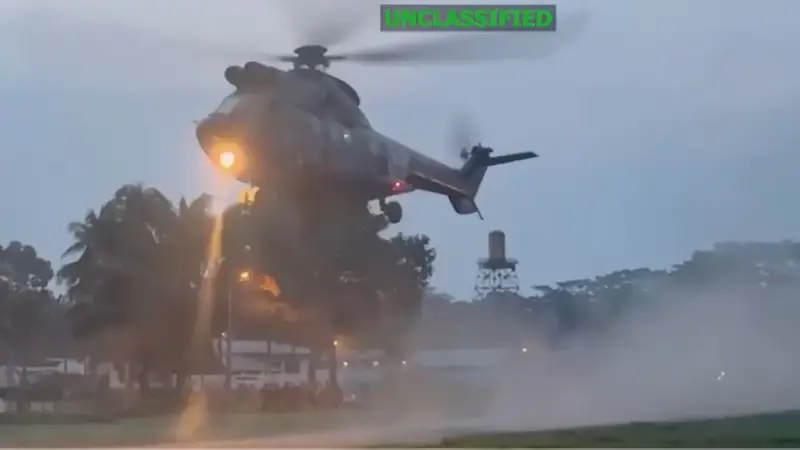
Now the operation has gone onshore. U.S. forces are on the ground in Ecuador, conducting joint operations with Ecuadorian commandos against groups the State Department designated as foreign terrorist organizations last September. The Pentagon announced it with a short video posted to social media — some helicopter footage, a SOUTHCOM statement, a general’s praise for Ecuador’s “unwavering commitment.” The extent of the American presence is unclear. The scope and duration of the operation are unclear. The Pentagon said it had nothing to add beyond the announcement.
Here is what is clear: last year, Ecuador’s President Daniel Noboa proposed a constitutional amendment that would have allowed the United States to operate a permanent military base in Ecuador. Ecuadorian voters went to the polls and rejected it in a referendum. The troops came anyway. The Pentagon sent forces to the former U.S. base at Manta — which is now technically operated by Ecuador’s military — in December, calling it a “short-term mission.” By March 3, it was a “new phase.” The citizens of Ecuador voted no. The United States military said yes. Democracy as a concept is apparently advisory.
Now hold all of that — Iran, Ecuador, the body counts, the constitutional violations, the congressional paralysis — and go back to that 4:30 a.m. Truth Social post.
“Iran tried to interfere in the 2020 and 2024 elections to stop Trump and now faces renewed war with the United States.”
Marc Elias, founder of Democracy Docket and one of the country’s leading voting rights attorneys, read that post in real time as the bombs were still falling and wrote: “The next Big Lie is taking shape right in front of us. Donald Trump will try to use this to assert illegal and unconstitutional powers over the 2026 elections.”
He wasn’t speculating. He was reading the draft.
A 17-page executive order, dated April 2025, has been circulating among anti-voting activists who say they are coordinating with the White House. It invokes the National Emergencies Act, the Federal Information Security Modernization Act, and the Defense Production Act. Its central claim is that foreign interference in American elections — from Iran, from China, from Venezuela, from whichever country is most useful on any given predawn Truth Social session — gives the president emergency authority to seize control of how Americans vote in the 2026 midterms. The order would ban most mail-in ballots. It would prohibit most existing voting equipment. It would require all 211 million registered American voters to re-register in person at a government office, presenting a birth certificate, passport, or naturalization certificate — documents that millions of eligible citizens do not have readily at hand. It would require hand-counted paper ballots nationwide. That last part should sound familiar. It’s the same hand-count conspiracy theory that turned Dallas County into a voter suppression dress rehearsal two days ago.
The people circulating this document include Peter Ticktin, a lawyer who has known Trump since they attended the New York Military Academy together, and Patrick Byrne, the prominent conspiracy theorist who urged Trump to seize voting machines after the 2020 election. Ticktin told WIRED that “there are many people within government who are looking at this and who are advocating for the executive order to be signed.” He declined to name them. But the document has also been in the hands of Kurt Olsen, currently a White House employee tasked with re-investigating the 2020 election. And the coalition behind it gathered on February 19 at a summit hosted by Michael Flynn — yes, that Michael Flynn — where topics included litigation strategies to contest the 2026 midterms and the mechanics of a presidential declaration of national emergency to seize control of federal elections. Among those in attendance was Cleta Mitchell, who was on the phone in January 2021 when Donald Trump pressured Georgia Secretary of State Brad Raffensperger to “find 11,780 votes.”
These people are not fringe. They have White House access. They have a 17-page draft. They have a pretext — and they have been building it, in public, with American bombs and American troops and American body counts, since February 28.
Legal experts have called the draft order legally defective. Constitutional scholars say the statutes it cites don’t actually confer the powers it claims. Colorado Secretary of State Jena Griswold called it “attempted authoritarianism.” Trump told reporters he was unaware of it - same trajectory of lies for Project 2025: never heard of it, no such thing, yeah, it’s a thing, we might like some of it… items have been ticked off of that since day one. The Washington Post reported the White House is considering the executive order now.
Both things track perfectly fine.
We have been here before — or something close enough to recognize. We know what it looks like when a pretextual emergency is manufactured to justify a power grab that would otherwise be indefensible. We know what it looks like when the apparatus of national security is turned inward, pointed at the electorate. We know what it looks like when a man who cannot tolerate the possibility of losing decides that the rules governing whether he can lose are themselves the enemy. We have read this chapter. We know how it ends if nobody calls it by its name while it’s still happening.
So let’s be precise. The wars are not incidental to the election strategy. The wars are the election strategy. Iran is the pretext factory’s raw material. Ecuador is proof the operation has no geographic limit. The 17-page draft is the finished product waiting for a signature. The midterms — November 3, 2026 — are the target. And the machine that produced all of it has been running in plain sight, named by its own operators, documented in their own words, announced at 2:30 in the morning on Truth Social by the man who built it.
He told you what this was for.
Believe him.
**Unfugginbelievable is an independent, reader-supported investigation into the things that make us want to flip a table — then flip it back over and document everything on it. Every claim is fact-checked. Every source is real. No ads, no sponsors, no corporate overlords telling us what to leave out. If this work matters to you and you want to keep us caffeinated while we do it, buy us a cuppa at buymeacoffee.com/unfugginbelievable. We’ll drink it while reading the next filing.**
Add comment
Comments