

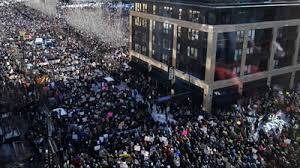
The country didn’t ease into January 30, 2026. It slammed into it like a wall. What was supposed to be an ordinary Friday became a coordinated national refusal to participate in anything resembling “business as usual.” People didn’t just stay home—they withdrew their labor, their spending, their compliance, and their silence. The result was a shutdown so widespread and so disciplined that even the administration’s most loyal spin‑artists struggled to pretend it wasn’t happening. Tens of thousands poured into Minneapolis alone, a city that has become the unwilling epicenter of the nation’s grief and fury after the ICE assassinations of Renee Good and Alex Pretti. The temperatures were brutal, the kind that freeze your eyelashes and make your bones feel like glass, yet the crowds kept coming. Early estimates put national participation in the hundreds of thousands as actions unfolded in all 50 states, from massive marches in major cities to small‑town main streets where the lights stayed off and the doors stayed locked.
Businesses joined the shutdown with a clarity that left no room for interpretation. In Bellingham, Washington, The Cabin Tavern taped a sign to its door that read like a declaration of independence: “NATIONWIDE SHUTDOWN! NO WORK NO SCHOOL NO SHOPPING — ICE OUT EVERYWHERE!!!” Village Books and Paper Dreams closed in solidarity, and Milwaukee saw its own wave of closures as residents rallied around the families of Good and Pretti. Across the country, countless small businesses quietly chose to close for the day, some posting statements, others simply locking up and walking away. The message was the same everywhere: if the government insists on terrorizing its own people, the economy doesn’t get to run uninterrupted.
The protests that accompanied the shutdown were a direct contradiction to the fear‑baiting that federal officials had been pushing for weeks. There were no riots, no fires, no convenient excuses for the administration to hide behind. Minneapolis saw tens of thousands march without a single major incident. Portland, Chicago, New York, Los Angeles, Atlanta, and dozens of other cities reported the same: peaceful crowds, coordinated actions, and a shared understanding that the power of the day came from refusing to give anyone in authority the narrative they were hoping for. Even smaller towns saw gatherings that were calm, focused, and unmistakably united.
The shutdown was the culmination of a month of escalating federal violence that the administration tried to frame as “law enforcement,” but which the public recognized instantly as state sponsored executions. Renee Nicole Good, 37, was murdered by ICEstapo agent Jonathan Ross in Minneapolis on January 7. Weeks later, Alex Pretti, a 37‑year‑old ICU nurse from Green Bay, was murdered by jackbooted thugs. These deaths were not isolated tragedies. They were part of a broader pattern under Operation Metro Surge, a federal initiative that has turned immigrant communities into targets and entire cities into militarized zones. The shutdown was the country’s answer: if the government refuses to restrain ICE, the people will restrain the country.
Schools felt the impact as students joined the walkout, building on earlier actions like the massive St. Paul student protests earlier in the month. Workplaces saw employees call out en masse, with labor unions in Minnesota and beyond supporting the broader movement. Retail traffic cratered in multiple metro areas as the call for zero economic activity took hold. The shutdown wasn’t symbolic—it was structural. It was a reminder that the economy is not a natural force but a human one, and humans can turn it off.
The demands were clear and impossible to spin. Withdraw ICE from Minnesota. Arrest the agents responsible for the killings. End the raids. Protect immigrant and international students. Defund or dismantle the agency that has become synonymous with cruelty. This wasn’t a polite policy disagreement. It was a moral ultimatum.
January 30 wasn’t a moment. It was a demonstration. A peaceful, coordinated, nationwide refusal to participate in a system that has made violence routine. A reminder that unity is more dangerous to the powerful than any riot could ever be. The administration wanted chaos. The people gave them discipline. The administration wanted fear. The people gave them solidarity. The administration wanted silence. The people gave them a shutdown so loud it echoed across the country.
And if anyone in power thinks this was the end of it, they’re about to learn what a nation looks like when it decides it’s done being ignored.
Add comment
Comments