

Let’s make sure we all understand exactly what just happened. Donald Trump filed a $10 billion lawsuit against the Internal Revenue Service… an agency that answers to him, inside a government he runs. He then “settled” that lawsuit with himself, through his own Justice Department, led by his own acting Attorney General Todd Blanche. You know, the man who, before taking that job, was Trump’s personal criminal defense lawyer. No independent court reviewed the deal. No judge signed off. The presiding judge, U.S. District Judge Kathleen Williams, noted that she had been “stripped of jurisdiction” before she could even rule on whether the lawsuit was constitutional in the first place. Trump’s own lawyers made sure of that, filing a dismissal that explicitly argued no judicial analysis was “appropriate.”
The result: a $1.776 billion fund - the dollar amount being a not-so-subtle patriotic wink - called the “Anti-Weaponization Fund,” controlled by a five-person commission appointed by the attorney general, with Trump retaining the right to remove any member at will. No judicial oversight. No congressional approval. No public input. Quarterly reports go to the attorney general. That’s it. That is the entire accountability structure. The attorney general reporting to the attorney general.
Columbia Law Professor Richard Briffault, who specializes in government ethics, called the original suit a “collusive suit” — because Trump sued his own government and settled the case between two entities he controls. He wants to know what the screening mechanism is. Does it matter what you were charged with? Whether you were under investigation? Whether you were convicted? Without public guidelines or a transparent process, he says, it’s “just kind of an open-ended slush fund.”
That is not an op-ed writer. That is a government ethics scholar at one of the most prestigious law schools in the country describing what will happen to your tax dollars.
The former pardon attorney at the Justice Department, Liz Oyer — who oversaw pardons and clemency before resigning in the first days of this administration — called it “the greatest abuse of the legal system in history, so far as I’m concerned.” She believes there is a “criminal conspiracy” between Trump’s legal team and the DOJ. There’s no transparency, she says. The five commissioners have total discretion. There is no oversight mechanism and no process for public input.
Let that sit for a moment. The woman whose job it was to protect the pardon process from abuse is using the words “criminal conspiracy.” That’s not overheated rhetoric. That’s a trained federal official with direct institutional knowledge describing what she sees.
Now let’s talk about who gets paid.
The fund is the latest in a cascade of retribution: Trump has already pardoned roughly 1,500 defendants convicted of crimes during the Capitol insurrection, stripped security clearances from perceived political enemies, fired dozens of DOJ staff who investigated him, and created a “weaponization working group” inside the department to review Biden-era prosecutions. The pardon, it turns out, was merely the appetizer. The fund is the entrée — paid for by every American taxpayer whether they like it or not.
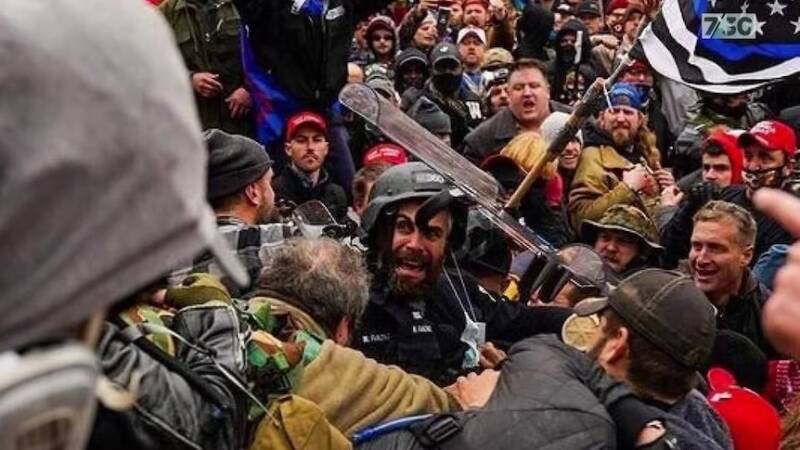
January 6th rioters, including those convicted of the most violent behavior during the attack and later pardoned, could likely apply for money. We are talking about people who beat police officers with flagpoles, deployed chemical sprays, used stun guns on officers’ necks, and shattered their way into the seat of American democracy. Over 600 rioters had been convicted of assault or obstruction of law enforcement. Over 170 had been convicted of using a deadly weapon. Trump pardoned virtually all of them. Now he wants to write them a check and call it an apology from the American people.
In April, the Justice Department moved to dismiss the seditious conspiracy convictions of Proud Boys and Oath Keepers members, undoing one of the most significant legal victories against the architects of January 6th. Oath Keepers founder Elmer Stewart Rhodes had been sentenced to 18 years in prison. Prosecutors documented that Rhodes and his followers stockpiled weapons for possible use by “quick reaction force” teams at a Virginia hotel on the day of the attack. He is now potentially eligible to receive a taxpayer-funded formal apology and a cash payment from the United States government. For planning an armed insurrection against it.
This architecture didn’t begin with the fund. A year ago, the Trump administration agreed to pay nearly $5 million to the family of Ashli Babbitt — a pro-Trump rioter shot while breaching the Capitol — to settle a wrongful death suit. Capitol Police Chief Tom Manger said he was “extremely disappointed” and that the payout “sends a chilling message to law enforcement nationwide.” The officer who stopped the breach of the House chamber… cleared of wrongdoing by two separate investigations… watched the government he served pay $5 million to the estate of the person he stopped. The fund is simply that logic, industrialized and scaled to $1.776 billion.
Michael Flynn has already settled two claims for at least $1.25 million. Anti-abortion activist Mark Houck, acquitted at trial, received $1.1 million from the Justice Department. These are not hypotheticals. This architecture is already paying out. The fund formalizes and expands what’s already in motion.
The structure was deliberately engineered to prevent interference. Trump’s lawyers went out of their way in their dismissal filing to stress that the judge had no role to play once he dropped the case. The judge agreed she had no jurisdiction left. Legal observers have floated challenges under the Emoluments Clause or the Administrative Procedures Act, but experts are largely stuck on standing, noting that the people being harmed are everyone, and courts don’t generally let “everyone” sue. In plain English: they built it to be almost impossible to challenge, and they moved fast before anyone could try.
“Once the government’s contractually agreed to pay someone who did not deserve to be paid, it’s very hard to unwind that,” said Richard Painter, who served as chief ethics lawyer for President George W. Bush.
Rep. Jamie Raskin put it directly: no one can be both plaintiff and defendant in the same case, and no president can manufacture a $10 billion lawsuit against his own government, settle it with himself, and call it law. Ninety-three House Democrats filed an amicus brief calling it a violation of the separation of powers, the Domestic Emoluments Clause, and the statute of limitations - a scheme to siphon billions of taxpayer dollars into the pockets of the president, his family, and his allies.
The Citizens for Responsibility and Ethics in Washington called it “one of the single most corrupt acts in American history.” Think about what that sentence means in a country that has seen its share of corruption. Not one of the most corrupt acts this year. Not this administration. In the history of the republic.
And we still don’t know who sits on the commission. Acting AG Blanche, testifying before the Senate today, did not name a single commissioner, said he had “no idea” whether Trump would make suggestions, and offered only his personal commitment to making sure the commissioners do their jobs. When pressed on transparency, he said he wanted to be “careful” given privacy laws that might restrict public disclosure of who receives payments and how much. They’ll take much more care with that than they did when they didn’t redact nude photos, names, addresses and other information on survivors of the pedophilia ring run by Jeffrey Epstein and Ghislaine Maxwell - and protected by the Trump regime.
Privacy. For a publicly funded loyalty disbursement program. The secrecy isn’t a bug. It is the entire product.
Here is what we are looking at: an unaccountable five-person board, appointed at will by an attorney general who is the president’s former personal defense lawyer, with $1.776 billion in taxpayer funds, no judicial review, no congressional authorization, no public process, and no requirement that recipients prove to any independent body that they were actually wronged. The commission can issue formal apologies in the name of the United States government and cash payments of unknown size to whoever it decides deserves them. Men convicted of seditious conspiracy. Men who beat police officers with flagpoles. Men who stockpiled weapons and planned armed opposition to the transfer of power.
Your money. Their reward. No receipt.
The number $1.776 billion was chosen to invoke American independence. The revolution. The founding. The irony is total. The men who stormed the Capitol tried to end the American experiment. The president who sent them there just made the American taxpayer say thank you.
**Unfugginbelievable is an independent, reader-supported investigation into the things that make us want to flip a table — then flip it back over and document everything on it. Every claim is fact-checked. Every source is real. No ads, no sponsors, no corporate overlords telling us what to leave out. If this work matters to you and you want to keep us caffeinated while we do it, buy us a cuppa at buymeacoffee.com/unfugginbelievable. We’ll drink it while reading the next filing.
Add comment
Comments