

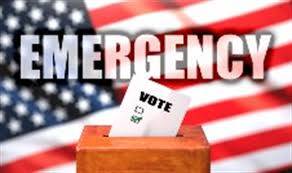
The thing about American democracy is that it’s supposed to be boring. Elections are supposed to be the civic equivalent of brushing your teeth: routine, unglamorous, and absolutely not something you want to improvise with at the last second. States run their own elections because the Constitution says they do, and for nearly 250 years that arrangement has held up pretty well. So when a 17‑page draft executive order starts quietly circulating among political allies — a draft that claims China interfered in the 2020 election and uses that claim to justify declaring a national emergency over voting — it’s not just a red flag. It’s the whole flag factory catching fire. According to reporting summarized by The Washington Post, the draft doesn’t just muse about election security in the abstract. It lays out a plan to treat ordinary voting methods as compromised infrastructure, the kind of thing you’d normally invoke when a foreign adversary hacks a power grid, not when Americans mail in their ballots like they’ve been doing since the Civil War. The draft asserts that foreign interference “causes a national emergency,” a phrase that should make every constitutional lawyer in the country sit bolt upright, because emergency powers are not a toy you hand to a president who wants to rewrite election rules on the fly.
The reporting describes a document that would open the door to banning mail‑in ballots, restricting or eliminating voting machines, and imposing new identification requirements nationwide — all under the banner of emergency authority. And here’s the part that would be funny if it weren’t so dangerous: the entire thing hinges on allegations of foreign interference that intelligence agencies have repeatedly said did not occur in 2020. Courts dismissed dozens of cases for lack of evidence. The former attorney general said there was no widespread fraud. State officials from both parties certified their results. Yet somehow, in this draft, the absence of evidence becomes the evidence of absence of control, and therefore the justification for seizing it. It’s the political equivalent of burning down your house because you heard a noise in the attic and decided it must be an invading army.
What makes this even more surreal is that the United States already has a system for handling elections, and it’s not a mystery. States run them. Local officials administer them. Congress sets certain guardrails, but the day‑to‑day mechanics — the ballots, the machines, the counting — belong to the states. That’s not a suggestion; it’s constitutional architecture. So when a draft order proposes using emergency powers to override state election laws, it’s not just bending the rules. It’s attempting to bypass the entire structure. Legal scholars quoted in coverage of similar proposals have pointed out that emergency powers like those in the International Emergency Economic Powers Act were designed for foreign threats, not domestic election administration. Trying to stretch them to cover voting procedures would trigger immediate legal challenges, because the president cannot simply declare a national emergency to take control of something the Constitution explicitly assigns to the states. Even the attempt would create chaos: states unsure which rules apply, courts scrambling to issue injunctions, voters caught in the crossfire of dueling authorities.
And that’s the part that should make everyone’s stomach drop. Because even if the courts blocked the order — and they almost certainly would — the damage would already be done. Confusion is a form of interference. Uncertainty is a form of suppression. If you can’t change the outcome, you can change the conditions under which the outcome is perceived. You can make people doubt the process, doubt their vote, doubt the legitimacy of the system itself. You can turn the simple act of voting into a question mark. And once you’ve done that, you’ve already won something far more corrosive than any single election.
The reporting makes clear that this draft didn’t appear out of thin air. It’s being circulated by activists and attorneys who have spent years insisting that American elections are perpetually under siege. They claim coordination with the White House. They say they expect the draft to influence future executive actions. They frame the absence of evidence as proof of a cover‑up, and the existence of normal election procedures as vulnerabilities. It’s a worldview in which the only safe election is the one you control from the top down, and the only legitimate outcome is the one you prefer. And that’s why this draft matters, even if it never becomes an official order. It reflects a willingness to treat elections not as a democratic process but as a national security threat, something to be contained rather than conducted.
What’s most unsettling is how quickly this kind of thinking becomes normalized. A draft circulates. Allies discuss it. Commentators debate it. Suddenly the idea of declaring a national emergency over voting — something that would have been unthinkable a decade ago — becomes just another item in the news cycle. But it’s not normal. It’s not routine. It’s not a policy disagreement. It’s a fundamental challenge to the structure of American self‑government. If a president can declare an emergency to control how elections are run, then the line between democracy and executive rule becomes dangerously thin. And once that line blurs, it’s very hard to redraw.
The facts reported so far are alarming enough on their own: a draft order exists, it claims foreign interference without evidence, it proposes sweeping federal control over elections, and it’s being circulated by people who say they’re coordinating with the White House. You don’t need hyperbole to see the danger. You just need to understand how fragile democratic norms become when emergency powers are invoked for problems that don’t exist. The real emergency isn’t the election. It’s the willingness to declare one.
Add comment
Comments