

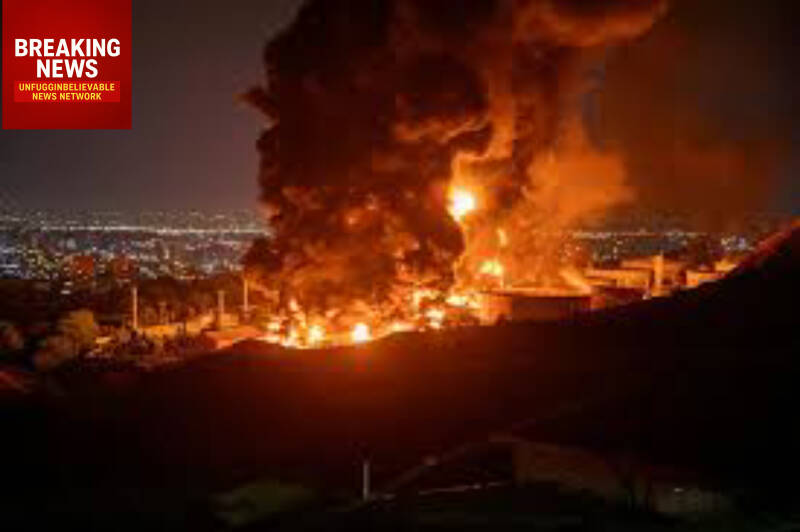
Let’s get something straight before we go any further. Donald Trump — the man who ran on ending wars, who called every previous military adventure “stupid” and “endless,” who accepted a Nobel Peace Prize nomination for conflicts he claimed to have ended, who built an entire political identity out of being the guy who doesn’t start fights — just launched “major combat operations” in Iran. He called it Operation Epic Fury. Naming their war mongering operations is the deepest thought they put into anything. He announced it on Truth Social. He told the Iranian people to “take over your government” and then immediately resumed bombing them. He told Iranian soldiers to surrender or face “certain death.” During Ramadan.
I need you to sit with that for a second.
The joint U.S.-Israeli assault struck hours after the two countries held their most recent round of nuclear negotiations in Geneva — on Thursday. Two days. They were at the table two days ago. A senior Middle East diplomat with direct knowledge of those talks told reporters: “Yet again, when negotiations get close to success… Israel has intervened to preempt diplomacy.”
This is not a war of last resort. This is a war of impatience, ambition, and ego. And someone has to say it plainly.
The strikes hit during the holy fasting month of Ramadan — a detail that is not incidental. It is a choice. Everything about this operation is a choice: the timing, the targets, the scale, the rhetoric. And choices have consequences, which means choices have authors. The authors here are Donald Trump and Benjamin Netanyahu, and history will not let them forget it.
Here’s what we know about what they hit.
Cities struck include Tehran, Isfahan, Qom, Karaj, and Kermanshah. Targets included Iran’s military installations, symbols of government, and intelligence facilities. Israel targeted locations where senior Iranian officials were gathered, with an Israeli military official telling NBC News that “several senior figures essential to the management of the campaign and the regime’s governance were eliminated.” Roads to Khamenei’s compound were shut down. The Supreme Leader has not been publicly seen. His foreign minister told NBC News he was alive — as far as he knew.
And then there’s Minab.
We need to stop here. We need to stay here for a moment.
In the southern city of Minab, an Israeli strike hit an elementary girls’ school. At least 51 people were killed and at least 60 more were injured, according to Iranian state media. Iran’s state-run IRNA news agency reported the death toll at 57. The numbers keep moving. They will not move in the direction of fewer. Fifty-seven people. In a girls’ school. During Ramadan. During what the Trump administration was still publicly calling a diplomatic process two days earlier.
We are still in the early hours of this. We will not claim to know every detail of what happened in Minab or why. We will not tell you the school was definitely a military target or definitely not one. What we will tell you is this: when you bomb a country with dozens of simultaneous strikes across multiple cities, and one of those strikes lands on a girls’ primary school and kills dozens of children, the answer to “how did that happen?” is not a shrug. It is not a press secretary producing three synonyms for “regret.” The answer is accountability. The answer is documentation. The answer is insisting, loudly and without apology, that the world does not look away from Minab. That the world does not let the news cycle churn past those girls and on to the next atrocity without naming what happened to them. Their names will come. We will say them.
Meanwhile, from the ground in western Tehran, a resident reached by phone before communications were cut said: “They have hit many targets around me and we hear fighter jets and missiles exploding. People were panicking and trying to get to their homes. Children are running out of school.”
Children are running out of school.
That is what “creating conditions for the Iranian people to take their fate into their own hands” looks like from the ground. That is what Epic Fury looks like to the people it lands on.
Now. Let’s go back further. Because this story has a paper trail long enough to wallpaper the Situation Room, and every single sheet of it has Trump’s fingerprints on it.
In June of last year, Trump launched Operation Midnight Hammer (it’s like 12 year old boys, cosplaying war in their best GI Joe regalia name these things) - 125 aircraft, 30,000-pound bunker-busting bombs, the whole spectacular apparatus of American military power — against Iran’s nuclear facilities at Fordow, Natanz, and Isfahan. The moment the last bomb landed, before a single damage assessment could be completed, before the dust had physically settled, Commanant Bone Spurs waddled to the nearest microphone. “Iran’s key nuclear enrichment facilities have been completely and totally obliterated,” he said. It was over. Done. Handled. The Iran problem, solved.
He kept saying it. And kept saying it. And kept saying it.
He said it in October: “It was obliterated.” He said it in November: “completely obliterated Iran’s nuclear capability.” He said it again in November: “We obliterated their nuclear capability.” He said it in December, in January, on Inauguration Day, on February 13th. Like a man who learned one word and decided to make it do all the heavy lifting for eight months. Obliterated. Obliterated. Obliterated.
There was one small problem with this narrative. An early classified assessment by the Defense Intelligence Agency concluded the three nuclear sites bombed by the U.S. weren’t completely destroyed, leaving much of the materials buried but intact. The DIA director who produced that report? Fired by Pete Kegsbreath two months later. Nothing says “confidence in your military success” like terminating the general who told you the truth about it. Truth is just so inconvenient for this regime. Rafael Grossi, the director general of the International Atomic Energy Agency — the actual experts whose entire job is monitoring this — said just ten days ago that most of Iran’s enriched uranium remained intact after the U.S. strikes in June 2025, and there was no indication Iran was working to develop a nuclear weapons capacity. No indication. The IAEA said no evidence of active weapons development.
Trump bombed them anyway. He called it self-defense.
And when KKKaroline Leavitt was asked how the obliterated program could possibly require another round of strikes, she offered this clarifying response: “Well, there’s many reasons and arguments that one could make for a strike against Iran.” Vapid bubbleheads are just so eloquent. The White House was still searching for a logically consistent one. They didn’t find it. They bombed anyway.
Then came Tuesday night. The longest State of the Union in recorded history — clocking in at nearly an hour and 48 minutes of Trump telling Congress and the American people how extraordinary everything was. The economy: magnificent. Inflation: plummeting. Gas prices: practically free. He said he’d ended eight wars. He called himself the guy who doesn’t start them. He accepted credit for a Nobel Peace Prize nomination from a man who cannot spell the word “deterrence.” He smiled that particular smile of a man who has never once in his life been asked to account for the distance between what he says and what is real.
Gas prices specifically. He cited $2.30 a gallon in most states. Some places, $1.99. In Iowa, he said, nearly $1.85. A woman in the audience fact-checked him in real time: the gas station right outside the venue where he’d recently spoken in Iowa was selling for $2.69 per gallon, with the state average at $2.57. The national average the day after his speech was $2.975. He was off by nearly a dollar. But sure. Economic miracle. Let’s build a legacy around that.
Meanwhile, unemployment has climbed from 4.0% in January 2025 to 4.3% in January 2026, hitting a four-year high of 4.5% in November. American consumers paid more than $231 billion in tariff costs between February 2025 and January 2026 — an average of roughly $1,745 per family. Electricity is up 6.3%. Housing is up 3.4%. Medical care is up 3.2%. But he told you gas was cheap, and he said it with the conviction of a man who has never personally pumped his own gas in his life.
This same man, in the same speech where he bragged about the economy he’s built, had to explain why the nuclear program he’d already obliterated was somehow still a threat. He told Congress: “They’ve already developed missiles that can threaten Europe and our bases overseas, and they’re working to build missiles that will soon reach the United States of America.” His own special envoy Steve Witkoff said Iran was “a week away” from having material for a nuclear bomb.
The obliterated country is almost fully operational. The totally destroyed program is nearly complete. Pick one, gentlemen. You cannot have both. But consistency has never been a feature of this operation — it is a bug, and they are fine with it.
Now let’s talk about the Board of Peace. Oh, you thought we were done? We are not done. In January, at Davos, Trump unveiled what he described as the most prestigious collection of leaders ever assembled in the history of human civilization. He called it the Board of Peace. He installed himself as its permanent, potentially lifelong chairman — no fixed term length; he holds the position until he resigns it. He controls the purse strings. He also named the institution after himself, then claimed he didn’t know about it. “Marco named it after me,” Trump said at the inaugural meeting. It was a surprise, he said. The Donald J. Trump U.S. Institute of Peace — seized from its actual staff, its actual leadership fired, its entire institutional mission redirected toward the glorification of one man. Now a branded backdrop for the man who, four months later, launched a war.
More than 20 countries agreed to join the board: Albania, Argentina, Bahrain, Egypt, Hungary, Indonesia, Israel, Jordan, Kazakhstan, Qatar, Saudi Arabia, Turkey, and the UAE, among others. Permanent membership would be granted to countries that contribute more than $1 billion in cash within the first year. The White House assured us this was not an entry fee. It was merely — and here I am borrowing the language directly — a demonstration of “deep commitment to peace, security, and prosperity.” A billion dollars. Voluntary. Just to show how much you love peace. Totally normal. Nothing to see here.
Key U.S. allies — the UK, France, and Canada — were not in attendance. Canada was actually disinvited. Trump posted on Truth Social that “the Board of Peace is withdrawing its invitation to you regarding Canada’s joining.” France and the UK declined because, as one diplomat put it, they were concerned the whole structure would sideline the United Nations and consolidate power in the hands of one man whose charter gave him unilateral veto authority over membership and executive board decisions. Their concerns, it turns out, were not unfounded.
The wealthy Gulf Arab states — Bahrain, Qatar, Saudi Arabia, the UAE — are the primary contributors. These are the countries that ponied up. These are the countries that kissed the ring, or at minimum arranged a formal introduction to the ring. And here is the detail worth sitting with, the detail that should make something cold move through you: those same Gulf states — the ones that joined the Board of Peace, that paid for proximity to American power, that bent the knee and wrote the checks — are now having missiles fired at them by Iran. Iran’s retaliatory strikes hit Bahrain, Saudi Arabia, Qatar, and the UAE. A missile attack targeted the headquarters of the U.S. Navy’s Fifth Fleet in Bahrain directly.
You paid a billion dollars for permanent membership in the Board of Peace. You are now being bombed.
The countries that declined? Watching from a safer distance as the region they were told had been stabilized comes apart at every seam.
And speaking of people who fixed everything the first time: where is Jared? Where is the brilliant architect of the Abraham Accords, the man who produced a 181-page economic development plan for the Palestinians, the man who normalized relations between Israel and half a dozen Arab states and was dispatched upon his return to public life to solve the Middle East all over again? Jared Kushner, whose investment firm received $2 billion from Saudi Arabia’s sovereign wealth fund, $1.2 billion from Qatar’s sovereign wealth fund, and significant investment from Abu Dhabi-based Lunate — all after his first stint as an unpaid government adviser during which he built exactly those relationships. The conflicts of interest aren’t buried in the fine print. They’re on the cover page.
The Abraham Accords were real. They were a genuine diplomatic achievement, and it is possible to acknowledge that without pretending they solved Iran. They were designed around the idea that shared hostility to Iran would bind Israel and the Gulf states together. That worked, until the bombs started falling on the Gulf states themselves. Because Iran is not a problem you solve with a real estate deal and a photo opportunity. And the gulf — pun very much intended — between “normalization agreement” and “stable Middle East” is apparently large enough to fly 125 aircraft through.
Which brings us to Little Marco. Marco Rubio, our Secretary of State, the man Trump once constantly mocked and who warned of the dangers of someone like “America’s Hitler” (thank JD Vance for that moniker) and dispatched to the kids’ table of American politics, now entrusted with negotiating one of the most consequential nuclear standoffs in recent memory. The Geneva talks concluded Thursday with what was described as “claims of progress but few details.” Two days. The administration gave diplomacy two days. Then, while Iranian and American negotiators were still discussing frameworks, while technical discussions were being arranged in Vienna, the bombs started falling.
You do not need a doctorate in foreign policy to look at that timeline and feel something cold and specific move through you. You need only to ask the question that keeps demanding an answer: were the talks ever meant to succeed? The largest U.S. military buildup in the Middle East since 2003 was already in place before a single negotiator sat down in Geneva. The aircraft carriers were already positioned. The munitions were already loaded. The senior Middle East diplomat who spoke to reporters after the strikes said it plainly: “Yet again, when negotiations get close to success, Israel has intervened to preempt diplomacy.”
Two days after Geneva. The bombs were already loaded when the diplomats sat down. The negotiations were not a process. They were a cover story. Geneva was a backdrop, a prop, a piece of stagecraft designed to let them say they tried — before doing what they had already decided to do.
And now here we are on the other side of it, watching a man who bragged about cheap gas prices four days ago ignite a warzone around the Strait of Hormuz. Here’s what that means for those gas prices he loved so much.
About 20 million barrels of crude oil pass through the Strait of Hormuz every day — nearly 20 percent of global liquid oil consumption. Iran has the geographic leverage: at its narrowest stretch, the shipping lanes fall entirely within the territorial waters of Iran and Oman. Iran’s parliament already approved a motion to close the strait. Any significant impact to that chokepoint would force oil above $100 per barrel — potentially sending gasoline closer to $5 at the pump. The same gas Trump was bragging about at $1.99 could hit $5 before the primaries. Financial analysts at Lombard Odier estimated that a temporary spike above $100 per barrel is entirely plausible if Iran moves to block the strait.
The people who will pay for this are not the people watching from Mar-a-Lardo. They are the people who drive 45 minutes each way to jobs that don’t offer remote work. The people whose grocery bills are already up. The people whose electricity is already up. The people who were told on Tuesday that everything was spectacular and who woke up Saturday to the news that the man who told them everything was fine had launched a war.
And Iran is not sitting still. Missile and air strikes have been launched across the region — against Israel, Bahrain, Saudi Arabia, Qatar, the UAE, and Iraq. Jordan intercepted Iranian missiles over its territory. Iran’s National Security Council has advised residents to leave Tehran. The Strait of Hormuz is now a warzone. Oil prices have already climbed to six-month highs, and that was before the retaliatory exchange got fully underway.
There is a through-line in all of this — one clean, ugly thread that connects the bragging to the bombs. It is the replacement of strategy with performance. It is a man who said “obliterated” eleven times over eight months and then started bombing the obliterated country again. Who said gas was $1.99 and it wasn’t. Who said he ended eight wars and is now starting another one. Who built a Board of Peace and is dropping bombs on its members. Who sent his son-in-law to fix the Middle East and then gave diplomacy forty-eight hours before deciding to do this instead. Who used Geneva as a stage set for a decision that had already been made.
The people who told you this was necessary are the same people who told you the negotiations had failed. The negotiations hadn’t failed. They were two days away from another round of talks when the bombs fell. That’s not failure. That’s sabotage. And sabotage has a name. His name is right there on the Truth Social post.
In the southern city of Minab, fifty-seven people went to school on a Saturday morning. Girls. Children. With notebooks and backpacks and whatever it is that children bring to school during Ramadan in a country that is now at war. We don’t have all their names yet.
We will get them.
We will say them.
We will not move on.
**Unfugginbelievable is an independent, reader-supported investigation into the things that make us want to flip a table - then flip it back over to document everything on it. Every claim is fact-checked. Every source is real. This is a breaking, developing story and we will keep updating as facts are confirmed. No ads, no sponsors, no corporate overlords telling us what we can say and what we leave out. If this work matters to you - especially today - buy us a cuppa at buymeacoffee.com/unfugginbelievable. We’ll need it to keep up with this developing nightmare of a story.
Add comment
Comments