

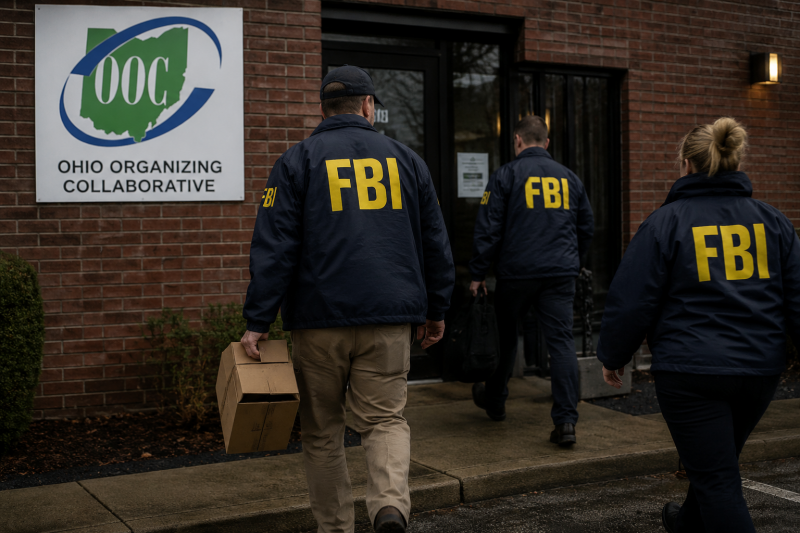
The FBI raiding a voting‑rights organization in Ohio would have been a five‑alarm national scandal in any functioning democracy, but in 2026 America it barely cracked the news cycle because we’ve all been conditioned to treat authoritarian creep like background noise, the political equivalent of tinnitus. Agents swarmed the Ohio Organizing Collaborative - a group that registers voters, organizes communities, and generally does the kind of civic engagement that used to get you a pat on the back instead of a federal search warrant - and the message was unmistakable: if you help people vote, you are now a suspect. The Trump regime has spent years screaming about “voter fraud” without ever producing evidence, and now they’ve graduated to the part where they use federal law enforcement to intimidate the people who actually expand democracy. It’s the same playbook as always: invent a threat, manufacture a panic, then use the panic to justify the crackdown you wanted in the first place.
And while the FBI was busy treating voter registration like organized crime, the Postal Service decided it wanted in on the fun. USPS, the institution that once prided itself on delivering mail through snow, rain, heat, gloom of night, and the occasional rabid raccoon, is now proposing a rule that would allow it to refuse to deliver mail ballots in states that don’t hand over detailed voter rolls to the federal government. That’s right: the agency responsible for delivering ballots wants the power to not deliver ballots. All states have to do is cough up lists of every voter receiving a mail ballot, complete with unique identifiers, effectively turning the Postal Service into a national voter‑tracking system. If states refuse, USPS can simply shrug and say, “Oops, no ballots for you.” This is being justified under a Trump executive order about “citizenship verification,” which is a phrase that sounds neutral until you remember it’s being deployed by a regime that treats voting like a crime scene and voters like suspects.
Civil‑rights groups are already in court arguing that this violates a 2021 settlement requiring USPS to prioritize election mail through 2028, but a Trump‑appointed judge has allowed parts of the new rule to move forward while litigation continues. That’s the trick: even when the courts eventually block something, the damage is done because the chaos itself is the point. If you can make voting feel unreliable, confusing, or risky, you’ve already won half the battle.
Meanwhile, the Trumpstein Legal Department (masquerading as the Justice Department), which under normal circumstances is supposed to protect voting rights, is now trying to assert more direct control over how states run their elections. The same administration that tried to overturn a national vote is now positioning itself as the arbiter of election “integrity,” which is like putting the fox in charge of the henhouse and then giving it a badge, a subpoena, and a press office. The Trump regime has been telegraphing this for years: centralize power, intimidate election officials, and create enough procedural chaos that any result they don’t like can be challenged, delayed, or outright rejected.
None of this is happening in a vacuum. It’s the culmination of a decade‑long demolition project that began with the Supreme Court taking a sledgehammer to the Voting Rights Act in Shelby County v. Holder (2013), freeing states with long histories of discrimination to change voting rules without federal oversight. Then came Rucho v. Common Cause (2019), where the Court shrugged and declared partisan gerrymandering a “political question,” effectively blessing map‑drawing that would make a cartoon villain blush. Then Brnovich v. DNC (2021), which made it harder to challenge discriminatory voting laws under Section 2 of the VRA. And while the Court surprised everyone in Moore v. Harper (2023) by rejecting the most extreme version of the independent state legislature theory, the damage from the earlier rulings had already been baked into the system.
On the flip side, courts have occasionally acted like the fire alarm instead of the arsonist. Dozens of judges, including many appointed by Trump, rejected his 2020 election lies for lack of evidence. The Supreme Court in Allen v. Milligan (2023) unexpectedly upheld part of the Voting Rights Act, forcing Alabama to draw a second majority‑Black congressional district. And lower courts have repeatedly blocked attempts to seize voting machines, purge voter rolls without due process, or impose last‑minute restrictions designed to confuse voters. But the pattern is clear: the judiciary sometimes stops the worst abuses, but it also created the legal landscape that made those abuses possible in the first place.
And now we’re in the part of the story where the Trump regime is no longer content to exploit the cracks in the system… it’s actively widening them. Raiding voting‑rights groups. Threatening to block mail ballots. Pressuring states to hand over voter data. Trying to federalize control over election administration. Flooding the zone with investigations, subpoenas, and rule changes designed to overwhelm the very people who make elections run. It’s not subtle. It’s not hidden. It’s not even particularly clever. It’s just relentless.
The strategy is painfully obvious: make voting harder, make election administration more chaotic, and make the public doubt any result that doesn’t favor the regime. If you can’t win a free and fair election, you don’t fix your politics - you fix the election. And the most chilling part is how normalized it’s become. A federal raid on a voting‑rights group should feel like a five‑alarm fire. Instead, it feels like Tuesday.
This is the coup continuing - in slow motion but gaining speed… the one that doesn’t need tanks or barricades because it has rulemaking, executive orders, and federal agencies doing the heavy lifting. And unless the remaining guardrails - the courts, the states, the civil‑rights groups, the voters themselves - hold the line, we’re going to look back on this moment and realize the coup wasn’t coming. It was already here, wearing a badge, carrying a clipboard, and asking for your voter file.
Add comment
Comments