

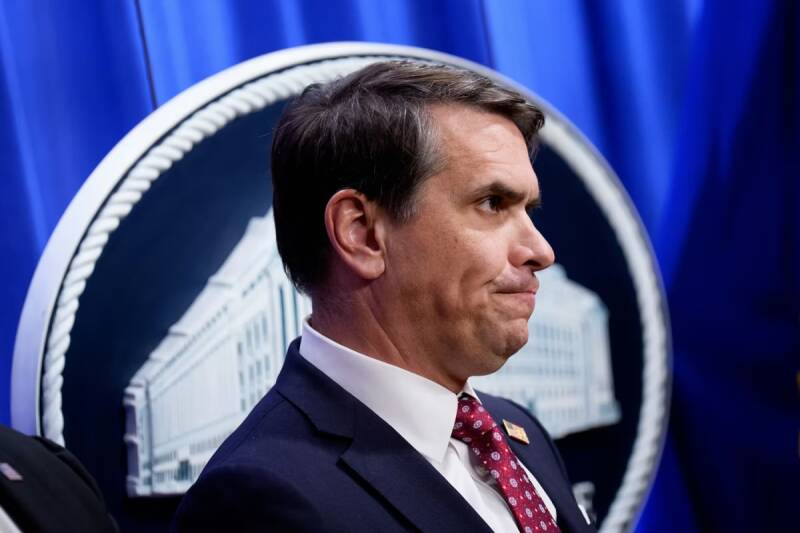
There are conflicts of interest, and then there is Todd Blanche testifying before Congress on Tuesday. The distinction matters. A conflict of interest implies the possibility of being pulled in two competing directions. What Blanche has constructed is something simpler and more brazen: there is only one direction, and that direction has always been Donald Trump.
Let’s establish the facts in the order they need to be understood. Todd Blanche was Trump’s personal criminal defense attorney. He represented Trump in the Manhattan hush money trial — the one that ended in 34 felony convictions for falsifying business records. He stood next to Trump on the courthouse steps every day. He was Trump’s lawyer in the federal election interference case and the classified documents case, both of which were dropped after Trump won the presidency and used that presidency to make them go away. Between March 2024 and December 2024, Trump’s Save America PAC paid Blanche’s firm nearly $10 million for that representation. At the height of the hush money trial, Save America was cutting Blanche’s firm checks of approximately $800,000 a month. Ten million dollars. From a PAC controlled by his client. To defend his client. That client is now the president of the United States. And Blanche is now the acting Attorney General.
On May 19, 2026, Blanche signed an order — as the acting Attorney General of the United States — that permanently bars the Internal Revenue Service from examining Donald Trump’s prior tax returns and blocks the agency from pursuing any pending claims against Trump, his family members, or any of his business entities. The document, in the Department of Justice’s own language, states that the United States “RELEASES, WAIVES, ACQUITS, and FOREVER DISCHARGES” all claims tied to the case, and is “FOREVER BARRED and PRECLUDED” from pursuing related actions against the plaintiffs. The plaintiffs are Donald Trump, Donald Trump Jr., Eric Trump, and the Trump Organization. The man who signed that order spent the better part of two years being paid by those plaintiffs to keep them out of legal jeopardy. He cannot see the conflict. “I didn’t — what are you saying is the conflict? I don’t understand what you’re saying,” he told Rep. Rosa DeLauro yesterday. “Listen, the fact that I used to have a job and I have a current job—” He genuinely said that. That is the acting Attorney General of the United States explaining that having previously been paid $10 million to protect someone from legal jeopardy, and now signing orders protecting that same person from legal jeopardy, is two different jobs and therefore fine.
Here is what the underlying lawsuit was. In 2022, reporting by the New York Times revealed that Trump had paid $750 in federal income taxes in 2016 and 2017. A former IRS contractor was later convicted of leaking Trump’s tax return data. Trump filed a $10 billion lawsuit against the IRS in the Southern District of Florida over that leak. The lawsuit was almost certainly going nowhere. Federal district judge Kathleen Williams, who oversaw the case, had already raised her own concerns about whether there was genuine adverseness sufficient to let the case proceed — pointing out that Trump was suing his own administration. She had set a deadline of May 20 requiring both sides to explain whether the suit was legally viable. The parties announced the settlement two days before that deadline. The case was withdrawn in a way that, as Trump’s filing explicitly stated, “terminates the action upon filing, and divests the district court of jurisdiction” — meaning: the judge never got to look at it. Multiple legal analysts noted that the claims were likely barred by the statute of limitations, since the conduct at issue had occurred more than two years before filing. Harvard government professor Ryan Enos called it, without hyperbole, “the most brazenly corrupt action in U.S. Presidential history.” Hours after the settlement was announced, Treasury Department general counsel Brian Morrissey resigned.
In exchange for dropping a lawsuit that was almost certainly dead, Blanche’s DOJ gave Trump three things. First, a formal apology from the United States government. Second, the IRS audit immunity order described above — which Rep. DeLauro, referencing reporting on the potential penalties Trump faced from ongoing audits, described as a tax immunity worth approximately $100 million to the Trump family. Third: the Anti-Weaponization Fund, a $1.776 billion pool of taxpayer money drawn from the DOJ’s judgment fund, to be disbursed to people who claim they were victims of “lawfare.” The five-member commission overseeing the fund would be appointed by the attorney general. The attorney general, again, is Todd Blanche. Removable by the president. The president is Donald Trump.
The fund exploded with predictable force. Democrats called it a slush fund for Trump’s political allies. Republicans — some of them — agreed. The concern driving Republican opposition was specific and not irrational: the fund’s language was broad enough that it could be used to send taxpayer checks to people convicted of assaulting police officers during January 6th. Capitol Police officers who defended the building that day filed suit to block the fund. A federal judge in the Eastern District of Virginia temporarily froze it. Senate Republican leaders were forced to pull a $70 billion immigration enforcement bill because enough members of their own caucus wouldn’t vote for it with the fund attached. Senate Majority Leader Thune made an unscheduled trip to confer with Blanche about it. The fund became, briefly, a problem.
So on Tuesday, Blanche sat before a House Appropriations subcommittee and said: “We are not moving forward with the fund. Period.” And let’s be clear — that headline is designed to end the story. The fund is dead, everyone can go home, crisis resolved. Except the audit immunity is still in place. Period does not apply to that part. The part that personally benefits Trump and his family and his companies remains fully intact. The part that would have benefited his allies — and generated bipartisan headlines about January 6th rioters receiving taxpayer checks — is the part that got killed. Team Trump abandoned the scheme that would have helped the president’s allies. They left standing the parallel scheme that helps the president directly. This is not a concession. This is a calculated retreat to more defensible ground.
And the ground has already been scouted for the next advance. Before the ink was dry on Blanche’s “period,” Senator Lindsey Graham posted on X that he appreciated Blanche’s statement but proposed creating, in his words, “a weaponization fund that will be available to those who can prove their claim against the federal government through the Federal Tort Claims Act.” Associate Attorney General Stanley Woodward responded to Graham’s post with three words: “We’re on it.” The post was later deleted. The intent was not. What this tells you is not complicated. The fund is “dead” in the same way Trump’s interest in paying his private political base is dead, which is to say it is not dead at all, it has simply changed vehicles. The Federal Tort Claims Act route would route any such fund through Congress, giving it legislative cover that the DOJ judgment fund gambit lacked. This is a feature, not a bug.
Because the people who were going to benefit from the Anti-Weaponization Fund — and the people who will benefit from whatever replaces it — are not abstract victims of government overreach. They are the human infrastructure of a political movement that the man in the White House may need to call on again. We saw what that infrastructure did on January 6, 2021. We watched it beat police officers with flagpoles. We watched it smear feces on the walls of the United States Capitol. Every one of those people who was convicted, pardoned, and is now awaiting a check is a member of what functions, in practical terms, as a private political militia. The gerrymandering may hold in 2026. The Voting Rights Act may be gutted enough to suppress the margins that would otherwise flip the House. The SAVE Act may create enough registration barriers to slow the damage. But if it doesn’t work — if the midterms go badly anyway — the people who showed up January 6th showed Trump what his options are. Keeping them paid, housed, loyal, and grateful is not a mistake or a favor. It is an investment.
This is Part One of what will be an ongoing series in this publication, because what happened on May 19th in a Miami federal court and what happened in Blanche’s testimony yesterday is not a single scandal. It is a window into a system. Donald Trump, his sons, his son-in-law, his cabinet members, his billionaire patrons, and the network of entities they control have been using the machinery of the federal government to generate personal wealth since January 20, 2025 — and they were doing it before that, and they’ll do it after, if no one stops them. The IRS settlement is one entry in a ledger that includes Pentagon contracts, Gulf state investment funds, crypto ventures, digital trading cards, a branded social media platform running on government goodwill, and a cabinet full of billionaires positioned to direct policy toward their own portfolios. We’re going to go through all of it. Line by line. Name by name. Number by number.
Because the scale of the grift is the story, and the grift has a name on every check.
Todd Blanche cannot see the conflict of interest. That is either the most expensive case of willful blindness in American legal history, or it is an audition. Given that Pam Bondi was fired last month and Blanche is now the acting AG, and given that he has spent the last six weeks re-indicting James Comey, indicting the Southern Poverty Law Center, and signing audit immunity orders for his former client — it appears the audition is going well.
Well enough, in fact, that the day after Blanche told Congress the fund was dead — period — Trump announced in a video posted by White House Deputy Chief of Staff Dan Scavino that he intends to nominate Blanche as the permanent Attorney General of the United States. “We are going to make him permanent attorney general,” Trump said. The White House called Blanche “an American patriot who fearlessly fought against the Democrats’ unprecedented lawfare campaign on behalf of President Trump.” On behalf of President Trump. That is the White House’s own framing of the job qualification for the nation’s top law enforcement officer. Not on behalf of the law. Not on behalf of the Constitution. On behalf of Trump. Blanche — who had previously insisted he was not auditioning for the role — will now face a Senate confirmation hearing. Senate Majority Leader John Thune, asked whether Blanche could be confirmed, said it was “hard to say.” Senator Thom Tillis, who sits on the Judiciary Committee, said he would oppose the nomination if Blanche equivocates on condemning January 6th. Trump, for his part, called the confirmation process ‘complicated’ but predicted it would move ‘very quickly.’ Translation: the same senators who just balked at paying insurrectionists with taxpayer money are now being asked to confirm the man who tried to pay insurrectionists with taxpayer money as the permanent head of the Justice Department. The audition is over. They’re negotiating his contract.
Add comment
Comments